Thursday, August 18, 2016

FALL CLEANSE

My controlled collection of "stuff"
In mid-August the texture of the air changes. I find weeds less worrisome at this time of year.  A riot of black eyed susans camouflage my end-of-summer laziness and I can look around with an equal sense of relief and appreciation. Thank you, Husband, for your diligent watering throughout a drought but thank god! it’s nearly over until spring. 

Now through Fall, we’ll be transplanting a few things, eliminating others, re-arranging, filling in, balancing the garden in terms of color, foliage, height.  This is called OBSESSIVE CONTROL! Every gardener has it. No matter how “natural” you lean, what “wide swaths” you cut or leave, you are manipulating your environment and therefore, join my club, you are a control freak. 

But here’s the thing: the obsession - owning, rearranging, controlling - doesn’t end outside my door with plants. It crouches inside with needy objects in every corner, every drawer, every cupboard.  Lee Randal  writes: “I am my things and my things are me.  I don’t want to give them up; they are narrative prompts for the story of my life.”

Whoa!  Had I only read that several years ago before I tried “staging- houses-for-fun-and-profit” or “staging-houses-for-people-even-when-they- didn’t-want-their-house-staged-but-I-thought-it-looked-better-anyway”…I could have saved myself frustration and those poor sods pain!  (“Poor sods” - I’ve been reading a lot of English literature lately.)

I’ve never made the leap from objects I own to some esoteric soul identity (could explain why we’ve moved 9 times in the last 40 years!) but an entire library of books written during the past dozen years by highly creditable psychologists explain it:  “The Comfort of Things” by Daniel Miller, “Why We Need Things for Psychological Stability” by Mihaly Csikszentmihalyi (remember him? he told us how to be happy years ago. It involved work…not things. I wonder when he changed his mind?),”Storage Hoarders” by Aggie MacKenzie.  

In 2001, British artist Michael Landy publicly put all his belongings through a shredder - 7,227 objects - in a performance piece he called “Break Down”. For a year afterward, he didn’t produce a single piece of art.  Randall believes Landy erased himself along with his “markers” and needed time for self-discovery. Obviously, Landy finally "found himself"; he’s still throwing things into the trash. Most recently, he invited artists on line to participate in a piece titled “Art Bin.”  130,000 gallon trash cans were placed around the exhibition hall into which Landy methodically tossed stacks of the“selected art.” So what is the message? that all art ultimately heads for a land fill? that any artist who would participate via the internet is asking for humiliation? that none of it matters and the only thing that survives are the metal containers used to collect this detritus?

 Landy is 53, still throwing things away and obsessed with NOT owning anything which opens up a whole new category of the human=objects dimension.

Jean Paul Sartre wrote that we can know who we are only by observing what we have. (!)    How does this “we are what we own” jibe with the environment?  All those objects that tell us who we are come at some expense - not just to us who bought the junk in the first place, but to the makers, packagers, transporters, sellers, power plants at each and every step of the process. What happened to last year’s Declutter Your Environment- Declutter your Brain? I’m a product of the era when obsolete by design was practiced, exposed and damned. Now are we to feel psychologically nude? 

“I am what I eat.”
“You are known by the company you keep.”
“Shorn of my possessions, I would still be me but not for long.”

No wonder some of us are still searching for our true selves: the  instruction booklet changes every year or two and I can’t read that fast!

~~~~~~~~~~~~~~~~~~~ 
A cartoon from The New Yorker shows a Japanese couple in traditional dress standing in the doorway of their home.  The corner of a tatami is turned up. A rice bowl and chopsticks are askew on the floor.
“Oh no!" says one. " We’ve been ransacked!”


Friday, July 22, 2016

ANOTHER ONE OF THOSE SOUL TALKS

I’ve been obsessing about death and dying lately and that should come as no surprise:  I am IN THE ZONE.  

You know “the Zone?”  Until about age 50, death is something “out there;” it’s part of life but even if someone dear dies, somehow it doesn’t quite pertain to the “us” at our core.  That starts changing sometime between 50 and 60.  

I began noticing the shift because I’m a classic movie fan.  I started counting the beautiful people in movies that were gone. There they were, in their prime, gorgeous bodies, at the top of their professions - all gone. I really mourned the loss: Paul Newman, Elizabeth Taylor, Gene Kelly, et. al. Is that weird?  

Then I had a serious illness and WHOMP! WE ARE NOT TALKING ABSTRACTIONS ANYMORE. 

For maybe a year or two I swung between “I am going to die soon” then, uh-oh,  “I did NOT die! So what am I supposed to do with this gift of time?” 
(Don’t start with that “value every day” stuff - it only adds pressure and stress! )

I did try a few things. I’m not a joiner but I joined. I’m not a good committee participant but I participated. I decided I should write my memoirs; they remain stalled in the early 1960s ( a LOT of things stalled in the 1960s!) I tried to keep an open communication line with the universe - “a door closes, another opens…but only if you’re ready.” I took a course in eastern thought and tried yoga.  I guess my doors were only ajar - nothing came to stay. 

I worked on “forgiveness” - I still do. It’s hard. Acceptance is another concept I can’t quite get my head around. When is it o.k. to accept and when do you fight like hell?  “Fighting…”is that merely trying to keep control? How does age and experience change my response to circumstances and how do I accept that my experience counts for very little in a culture of age discrimination?  (I often know the answer to a lot of stuff! Really! I’m a reader - a studier - a critic! but am just too damned disgusted to share them ONE MORE TIME with you immature morons! Don’t you people over 60 want to tattoo that one on your blouse or something?)

So here we are. More people are dying that I know and the obits list new “members” every day who are my age - sometimes younger, sometimes only a little older - and I am sad. But I enclose two wonderful poems that I really like because they make me feel better (Light bulb moment:  good writing can have that power!) and  a photograph of one of my all-time favorite “houses of worship.” You gotta’ love the human spirit!

I could be hit by a truck tomorrow or live long enough to actually pay off the house mortgage.  In the meantime, fuck it! I’m buying the chair!


Tuesday, July 12, 2016

A GARDENER'S VIEW

Do you garden?   Why?

Unless you grow food as part of survival, or raise cash crops and harvest and reproduction are the basis of your livelihood, then the answer to these questions require thoughtful consideration. 
Ancient Chinese, the first gardeners to intentionally transform their outdoor environment, created gardens to seduce the gods. Their thought process went “ if I make this garden beautiful enough, or enough like the place where the gods live (Garden of Eden? No, that’s the Christian version. Chinese thought the gods lived in the mountains, hence the imitation of clouds, mountains, lakes in oriental gardens.), then the gods will want to stay here with me and since they live forever, they’ll let me live forever too! 

Clever those old Chinese! They were looking for life everlasting and that’s a great answer to my original questions. Planting an oak tree or gingko or giant sequoia is a nod toward immortality. These and other great trees live several human lifetimes. Otherwise, those of us who require instant gratification plant fast growing weed trees and let’s face it, they are mere chachkas - landscape junk.

I garden because I like balance and composition and I try my very best to impose my idea of both in my environment. (And sometimes yours! I get into trouble with that one. I have a little trouble with boundaries.)  

I am not a plant collector; many gardeners are. They can’t resist including a new/unusual/exotic to their growing banquet. There is never too much or too many; you collectors will always find a place - even inches! - for one more little beauty. (Enter the Victorians and their lust for exotics from around the world - the age of botanical exploration. And now, the inner net provides the world view and world market for plant collectors. It's much easier than bankrolling a two year excursion to some tropical paradise. And Federal Express guarantees 24 hour delivery from even the remotest destination.)

Nor am I a specialist.  If you are, you now own hundreds of varieties of a single plant (and can name them all!) -  day lilies, peonies, hostas, ferns, or roses. You transformed your “garden” into “laboratory."  I happen to think your gardens are a bit boring - a one note samba? - but a specialist soon becomes the go-to person in their field and that's another good answer to "why" garden. 

No.  For me,  gardening is all about control and domination and aesthetic taste - mine.   But even a control freak like me begins with some rules and limitations: perspective, color, texture, climate, soil conditions, and space limitations.  

So I travel around the country scouting other gardens and meeting like-minded people who have staked out their patch of sacred ground.  We all wring our hands and lament the things out of our control: lack of rain, too much rain, ALWAYS those dreadful-awful-nasty deer/rabbits/groundhogs/chip monks/squirrels/birds sometimes/the neighbor’s cat/ the latest invading armies of beetles/ imported weeds that nobody knows how to control….the list is longer than gardening history!

We knew before reading the latest scientific news that trees communicate with each other (stranger than science fiction - look it up), that home grown is healthier than store-bought, that weeding is mentally therapeutic and that our mothers were right and sharing plant cuttings and seeds with each other forms a bond like no other.

We are a family of strangers connected by this shared interest.
````````````````````````````````````

I have a new app on my smart phone thanks to my dear friend Beverly. It’s myGardenAnswers. Easy to use and identifies from photo nearly instantly. 
I have another one called leafSnap and it’s a huge pain. Too complicated. Don’t bother.

``````````````````````````````````````

Garden Walk Buffalo is always the last week end in July and if you want to be truly inspired by the power of an idea that one couple had in 1993, go to the web site and read the history of this event that now includes free tours of over 400 gardens in Buffalo neighborhoods.  Power to the People - Power to Gardeners! 


Monday, June 13, 2016

THE GLENSTONE MUSEUM EXPERIENCE

What would you do with several billion dollars?
That’s BILLION - with a “B”.

We all daydream as we plunk down our dollar for the Lotto ( Listen sometime to Brandy Clark sing “we pray to Jesus and we play the Lotto”…) Probably the dream goes ….First, I’ll pay all the Visa/Master Card charges, car payments and mortgages for me, my family, the person who sold me the Lotto ticket and maybe one or two total strangers. I’ll set up trust funds for all my grandchildren and/or nieces and nephews (then, naturally, much time is spent on how this should be done.  We don’t want the kiddies to be spoiled…they must learn to work and not feel entitled…so maybe the $$$ is protected until they reach age…21? 35? first house? first marriage? And we won’t pay anything to cousin Tim who is a drunk and would just re-mortgage his house anyway and why should I give anything to that pimply faced clerk who sold me the ticket at the SuperKiss. He was rude!)

Finally, it occurs to you that this is getting too complicated. Give all the money away! But how? Too whom? How far will several billion dollars go anyway in today’s world? (Just ask Bill and Linda Gates! I don’t think they’ve found the right combination yet…but they do keep trying.)

Mitchell and Emily Rales hit on the solution that apparently is right for them.
In the 1990s, they spent oodles amassing a great contemporary art collection (post-WWII).  Then they bought several hundred acres in the rolling hillside of Potomac, Maryland - the very same general area where other zillionaires built country estates hidden from any road with miles of driveways through quaint painted fences (Ever been there?) - and hired a well-respected architect to design and build their house, their pool house and a small museum.  Another highly qualified landscape architect worked with artists and architect to mold the acreage. All this magnificence opened in 2006 (presently, a larger museum ‘annex’ is under construction to be complete in 2017-18.) It’s public - with a few caveats.

First, it’s only open Thursday through Sunday, 10 am - 4 pm. And you must make an advance reservation. Each hourly group is held to 20 max. visitors. And you must be with a guide at all times. Of course, you are not allowed near the private residence (reasonable request). There is really no such thing as “going off on your own.” Your movements are followed via walkie talkie and within minutes, a guide is at your side.

Relatively few people know that Glenstone exists and the board (yes, it’s a non-profit and has board members) wants to keep it that way.  One told me “We want visitors to appreciate the experience without feeling crowded.” Word goes out via the odd newspaper report but they spend zero on advertising or outreach.  They mount changing exhibits in the museum but only from their own collection.  None of that “PRE-PACKAGED TRAVELING SHOW” business. (They do “loan” out works from their collection to other museums.) 

Is this good? Bad? Who cares? 
Is it different from the Phillip Johnson Glass House? (Admission via reservation.) 
How is it different from Crystal Bridges Museum, opened just last year in Bentonville, Arkansas, the whim of a WallMart heir?
What about Storm King? Private collection - open to the public - much older and larger but not exactly on everybody’s radar screen.

I guess being a billionaire comes with its own set of problems. I’ll never know. But one thing is clear:  people - A LOT OF US! - will travel to find these places and put up with the rules for the chance to see some extraordinary art/architecture.  I will always reserve a seat on that bus. 


"Split Rock", Jeff Koons, 22,000 live plants re-planted every spring. Interior watering system.

Andy Goldsworthy, site specific, one of 3 stone houses that protect a clay orb inside.

Richard Serra site specific

Tuesday, May 24, 2016

PURYEAR AND OTHER MAGIC

Here is a sculpture by American born artist Martin Puryear.  Mr. Puryear  will be 75 years old in the next few weeks - exactly the time his one-man show will open at the Smithsonian American Gallery in Washington, D.C.  It so happens that I will be in Washington, D.C. just about then and if all goes as planned I will view “Vessel” and the other eleven sculptures personally - all within arm’s length.  I can hardly wait.

There’s a nice video conversation with Mr. Puryear making the rounds on YouTube and Facebook (at least, among my fb friends) and the way he talks about his art is refreshing.  

He says that he was trained and became “art aware” at a time when art did not need to be evangelical; it did not need to comment on the human condition nor lament -or predict - the state of the world (interior or exterior). Art could be simply itself…an object…an image sitting in space to be visually explored, intellectually examined, pondered over on other than socially significant terms.

I am thinking that this is fundamentally the difference between art of perhaps the “older generation” - whatever that means - and art of today when everything must be loaded down with extra spices.  I’ve become bored with all this world-weary hype.  Too many young artists seem to believe it’s their duty to tell us their inner-most secrets - to believe that this is the only valid art expression.

To which I say “get over yourself” and listen to Mr. Puryear and go see his sculpture if you can.  And for god’s sake, learn your craft!  And if you get the chance, conspire with an artist from another discipline. What can be better than sharing a stage with the Garth Fagan dancers as Puryear has done…or designing brilliant sets and designs for the opera “Madame Butterfly,” ceramic artist Jan Kaneko’s challenge…or stage sets for the Portland Ballet theater as glass artist Dale Chihuly successfully created.

Art may be pursued and perfected in what seems solitary confinement.

But laced together with the geniuses of other artists whose aim is…to reach heaven? Gloom and doom are words simply not in that vocabulary.

Friday, April 22, 2016

ROCHESTER: A LITTLE ABOVE AVERAGE

Susan B. Anthony, Mt. Hope Cemetary, Rochester, NY
Sometimes my home town gets it right!

For those who may not already know, Rochester, New York, was home to Susan B. Anthony - her modest family home is a little museum and there’s a tiny park near her house with a bronze sculpture of Susan B. sitting with Frederick Douglas having tea (Douglas lived in Rochester too and published his NorthStar newspaper here.)

This week was Voting Day ( 2016 Presidential Primaries) and here at Susan’s graveside, women left small bouquets of flowers but even better, plastered their “I Voted” stickers all over her gravestone.  Now I ask you…is that not way cool?  I can’t think of anything better, any way more appropriate to acknowledge the gift that she and those early mothers, sisters and aunts gave us.

Now….VOTE…next November…and every chance you get.  People actually suffered for our right to mark that ballot.
```````````````````````````````````````````````````````````````

I want a “studio craft museum” here.  It makes sense historically and philosophically and (cross my fingers) financially.  We sit in the very cradle of craft renewal.  Roycroft is just up the road, Stickley is just a short jont uphill, and Shakers are not far away. Swedes settled Jamestown to build furniture in high end factories. Alfred University (school of ceramics) isn’t far away, Corning Glass is about an hour’s drive, School of American Crafts is here at Rochester Institute of Technology.  What could be more sensible?

THE NEW YORK TIMES article in today’s paper speaks to the huge imbalance between the Museum of Modern Art and the Metropolitan Museum of Art. They make a strong case that all the $$$ and attention (attendance too?) is headed toward contemporary art. MOMA is booming; the Met is in trouble. 

O.K., I get it.  But people like making things and they love seeing what other people make and they fantasize that if only they had the time/studio/material they too could turn out beautiful stuff but in the meantime, they want to see, touch and add the handmade and unique to their own environments.  I believe this! I’m willing to try convincing other people to believe it. 


So what shall we name this new Rochester place? I’m thinking “Hands”…”Made by Hand”…”The Annex?”
"Taking Tea" bronze by Pepsy Kettavong, 2001

Sunday, April 3, 2016

THE GENIUS OF JAMES JOHNSON

Jim Johnson died last month. Johnson was an Oklahoma boy (my home state) but he landed in Rochester, New York, in the early 1960’s and spent his entire career designing nearly-always-interesting-nearly-always-controversial buildings.  

The Johnson designed synagog on Penfield Road is maybe one of the most beautiful sanctuaries I’ve ever been inside. Temple Sinai is a modestly sized structure that’s nestled in the woods on a lot that probably nobody else wanted in the mid-1960s; train tracks run all too close to the parking area and Penfield Road is a neither- here -nor- there entry to country-suburbia, hardly the epi-center of a sophisticated Jewish support base. But there it squats. The recent addition of a covered entry gives the building a becoming Oriental flourish but mostly, from the outside, the architecture is entirely ignorable.

The magic happens inside the sanctuary. The two long side walls made of roughly formed concrete lean inwards; the ceiling is one giant window to the sky. Clouds float overhead; ivy grows up the walls toward the light. 

The altar is the place for brilliantly designed furniture by Wendell Castle who was proving to the world his special genius of freeform design.  These sit in the foreground of another total glass wall. Just outside this window wall are two skinny, building height pillars of concrete representing the tablets of Moses and finally, the woods beyond. 

Temple Sinai is about as perfect as any building can get. It marries exquisite form, materials, and setting in a way that inspires awe/worship/reflection. 


Temple Sinai, Altar/Interior (above)

Another of Johnson’s remarkable structures is the tiny catholic chapel in Naples, New York. Ugly as a mole on a witches chin on the outside, the inside of the chapel feels like a living, breathing Christmas tree that somehow you found your way to stand inside at its very trunk while glowing disc of colored lights dance around.  You need to experience it to believe it.

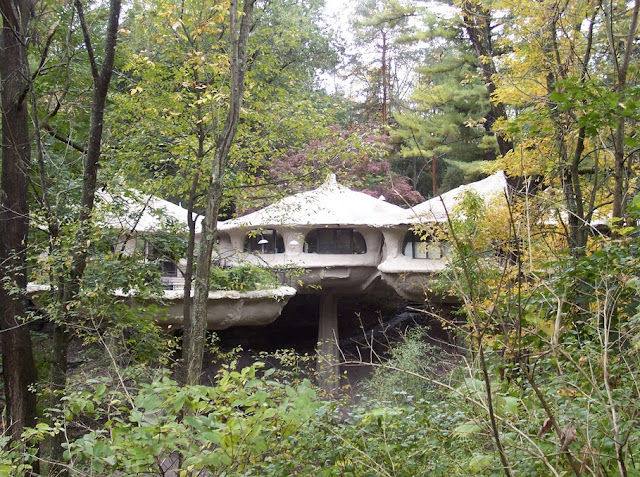
Johnson loved concrete.  His personal home - which is for sale right now  - is classic Johnson (concrete with swooping cedar shingled roof). The Mushroom House in nearby Fairport is another concrete formed building.  Another house backs to the woods off Clover Street and is a smaller and slightly earlier version of his own house. I could not live five minutes in any of these houses. They are cold, off putting spaces with little regard for human participation and family building. Nor do they particularly pay attention to the site in which they occupy. None of the three especially open to what’s outside their cement walls.

 But here’s the thing:  I don’t require an artist to make a masterpiece every time they enter their studio. One masterpiece in a lifetime - one brilliant  painting, song, poem or building - is enough to prove the evolution of humankind and that geniuses still walk among us.  

To have completed two or three? Johnson can rest easy; he got there.   

James Johnson personal residence, Penfield, New York—now for sale (above)

The Mushroom House, originally built for Robert and Marget Antell (below)