Wednesday, March 18, 2015

A TRIBUTE TO MICHAEL GRAVES

In my next life, I want to be Michael Graves. If given a “do over”, I aspire to being an architecture but not just any architect. If I’m making a choice: famous painter vs. ——, discoverer of cancer cure vs.——, or writer of the great transcendent novel vs. —-then my —- must be Michael Graves (Susan Susanka, a close second.) 

Michael Graves died March 12, 2015.  He was 80 years old. He was paralyzed from his mid-chest down following an illness 10 years ago. But he continued to teach at Princeton and gathered a team of devoted designers - many of whom were former students of his - that stayed together for 50 years.  The Michael Graves team developed everything from hotels to salt and pepper shakers, hospitals to tea kettles, schools to ironing boards.

And that’s what I want to talk about. In the 1980s, I watched a massive swing in the craft world. The movement that began in the 1960s as a re-awakening of crafts - a reverence for the art of handmade - took a big detour into the realm of ART. 

The 60’s and 70’s were a whirlwind of exploration and discovery: how to actually build a functioning art glass studio, build a forge independent of a major factory, create and fire clay in ways used by Chinese master potters who worked 2000 years before. These were remarkable achievements and brought with them a lifestyle: “the way of the artist.” 


Colleges began turning out graduates with degrees in fiber, wood, metal, clay and inter spliced was a philosophy that “sculpture” got more respect (museums, academics, critics) and pieces titled “art” commanded higher prices. From then on it seemed that nearly everybody began making objects described as the “essence of a chair,” “teapot forms”, or whatever thing that looked vaguely recognizable but with no earthly utility.

At about the same time, Michael Graves picked up the thread from Morris: “Do not have anything in your house that is not beautiful or useful…and aspire for BOTH!” (That isn’t a direct Morris quote…I’ve improved.) The Graves team launched a line of beautifully designed objects that nearly any homeowner could purchase. First produced by expensive manufacturers like Alessi, the Graves team went full out with the same level of design for Target - a $20 toaster or a $4.99 colander.

Some of the clay/wood/metal/textile/glass people have persevered; most have not. The world can only use a limited number of “teapot forms.”  Graves team set out to improve design for average households and it’s that intent that sways me.

(An exhibition of design and objects created by Michael Graves is on view through April at Princeton.  For information:  www.pastasprologue.com
A memorial in his honor will be held at Princeton, April 12.

(Photographs:    I love the colorful cubes of St. Coletta School in Washington, D.C. built for children with intellectual or multiple disabilities.  The houses are part of the Wounded Warrior Home Project at Fort Belvoir, Virginia. This is a fascinating military housing project for soldiers with physical limitations following service in Iraq or Afghanistan and their families.  The colander is available at Target.)


Tuesday, March 10, 2015

JUST CALL ME “GRUMPY”

Memorial Art Gallery has me spinning in my juices again. 

First, let me give applause where it is due.  The new manager of the Gallery Store is doing a superlative job! The space looks good. Positioning a small jewelry case as transition between totally wasted hallway space leading into the store was brilliant. The entry now seduces you inside.  Inventory is well presented and thank heaven! It’s still filled with original, hand-made art and objects. (To see a gallery store that is NONE of those things, visit Burchfield-Penney in Buffalo.  The building is beautiful. The gallery store is filled with “museum repro” junk.)

The true test of MAG store success? I spent $$$ both times I visited recently and let’s face it, there is a bottom line and it’s sometimes hard to adhere to prinicipals and still produce income.

So who came up with the idea for the new MAG lecture series? Inviting respected artists/designers/writers to talk about their hobbies? I don’t get it. Why should I care that world reknown furniture maker Wendell Castle likes vintage cars? I want his thoughts about collectible furniture and who’s designing it. (Disclaimer: I don’t know if Wendell is a booked speaker or if he is, what his topic.  He’s also a life-long tennis player - just an idea.)

John Beck as speaker? Terrific...he’s one of the world’s leading percussion instructors (retired) and I can’t get the movie WHIPLASH out of my head. I’d love to hear a conversation about his profession and he’s ideally qualified to talk about it but his hobby of WINEMAKING?  I personally can name a half dozen basement winemakers. Their conversations are alike and equally boring to someone like me who simply doesn’t care as long as the chardonnay is good.

A world leading japanese garden designer lives in Ithaca. He makes ceramic pots sometimes too. Which would you like him to speak about?

One day years ago when Dawson Gallery was still an East Avenue “destination”, a youngish woman came in to see a show and as usual, conversation followed. It turned out she was a leading restoration expert of antique museum quality textiles. She spent time in museums all over the world and had staved off malaria and almost died from a weird lung fungus during her work and I wondered then “why haven’t I ever heard of her?” I don’t know what her hobby was but boy, the lecture she could give on a topic most of us know little about.

```````````````````````````````````````

Graffiti....wall murals. I’ve written before and I’ve done more research and yes, I know that some historic wall murals are invaluable and graffiti existed probably from the first neanderthal picking up a piece of shale to draw on a cave and both have added to our evolutionary sense of aesthetics and social progression.

Nevertheless, I’m conflicted. Here are two reasons. Our national parks are becoming prime attraction targets for “muralists.” These two examples (and I won’t divulge names of the makers) are at Crater Lake and Southern Utah. 

I admit it:  I like Banksy.  I like the total latino influence of certain urban neighborhoods.  I dislike the growing traveling band of painters whose images are interchangeable whether it be Berlin or Rochester, New York. I see no difference between what they do and any billboard except that painted walls last longer and are totally ugly as they deteriorate.

Oh my....just when I have the issue of life’s meaning figured out, here comes another mental wrestling match.


Wednesday, February 25, 2015

INSTALLATIONS AND GEORGE ELIOTT

I need to re-read MIDDLEMARCH and troll through the mind of George Eliott; she’s tapping me on the shoulder. (How do these authors find me? I was minding my own business reading a bit of fluff when I happened to pick up an old book by Rebecca Mead, “My Life In Middlemarch,” and started thumbing through pages, stopping at passages I’d underlined years ago. And there she was - Eliott grabbing me by the shoulders for a good shake.)

To the extent that she had a faith, Eliott called it “meliorism” - the conviction that through small, beneficent actions and intentions of individuals, the world might grow to be a better place.

Eliot was not concerned with showing the effects of large, heroic acts performed by extraordinary people. She was more concerned with changing the reader’s perspective than she was in encouraging that reader to contribute to soup kitchens.  Her mantra: If I really care for you - if I try to think myself into your position and orientation - then the world is bettered by that effort. If you respond to my effort by extending the same sympathy and understanding to others, then the world has been minutely but significantly changed for the better.

In the search for a life of grace, this looks like a promising path.

`````````````````````````````

INSTALLATION ART is usually inside (outside = land art, public art). It can be permanent or temporary. The creator intends to change the viewer’s perception and force the visitor to reconsider space, nature, or ideas by taking charge of a space and loading it with disparate items. The transformation can be heightened through use of smell, sound or touch and/or an invitation to visitors to participate in the experience. 

Installation art became a “thing” in the 70s but actually Walt Disney knew all about this idea of skewing perceptions when he designed and built Disneyworld in 1955. I think any good garden designer or architect practices the same slight-of-hand. 

Here are some photographs. The balloons billowing out of an empty building (“Family Memories”) and floating out of a basketball hoop are pieces by french photographer Charles Petillon. The “Tea House” by Judith Olson Gregory featuring walls of paper scrolls made from used tea bags was installed at Burchfield-Penney Gallery in Buffalo. My favorite all-time gardener Vinnie Massaro turned his tiny slice of city garden into a Grimm’s fairy tale setting.

Which brings me back to SANCTUARIES and the architect’s gift for creating environments. Here are two examples. Designed by Rochester architect Jim Johnson, Temple Sinai is simply transformative. Added bonus: all the altar furniture was created by Wendell Castle. The catholic church is in Naples and I’ve always called it “Our Lady of the Grapes” but it’s actually titled something much more sonorous. Those glass inserts cast in concrete walls?  Standing inside the sanctuary is EXACTLY like standing inside a Christmas tree. 

Johnson had some building misses but I think these two hits are enough to get him into heaven.


Wednesday, February 18, 2015

THOSE CRAZY ARTISTS!

I went to a wedding in St. Louis a few years ago and during down time, visited the 96 acre Laumeier Sculpture Park, a good idea gone bad.  It was dismall, deserted, and worn weary. I could almost hear the sales pitch when the idea of this place was presented and dedicated; I made a few of those myself back in the day. But I came away thinking you can build anything you want - that’s the easy part! -  but without on-going dedication to impeccable maintenance, you’ve done more harm than good to the idea of public art.

Just as I sank into despair, I came to the Missouri Botanical Gardens smack in downtown St. Louis. The 79 acres were dedicated in 1859 making the MBG the oldest continuing botanical garden in the nation and it is spectacular.  And there is art everywhere! And it’s good! And installed beautifully! And people who work there seem to know about it and share information! I haven’t delved into the $$$ sources for these places. I’m betting that there’s a gulf between the bankrolls of these two. Why?

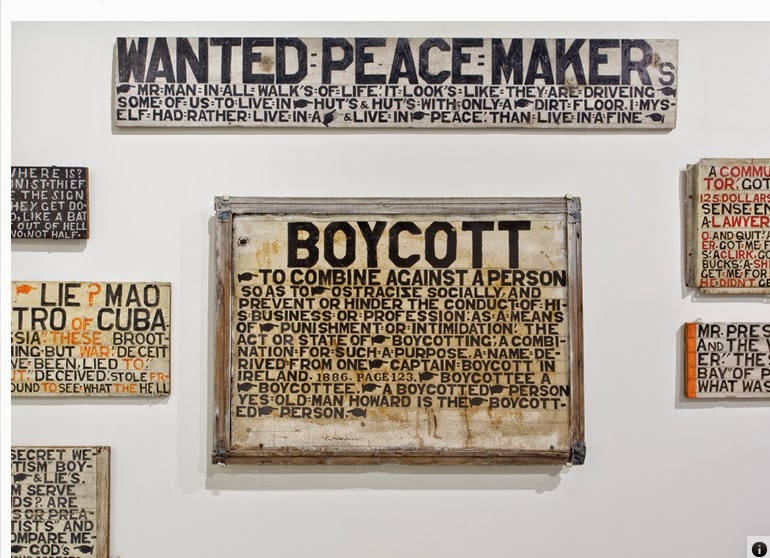
Meanwhile, I’m ready to go back to St. Louis and visit the city’s Contemporary Art Museum where the first in-depth solo exhibit by folk artist Jesse Howard is installed. 

Howard was a crank, a pre-Rush Limbaugh crazy who spent his time painting signs covering his 20 acres in Fulton, Missouri, damning to hell his neighbors, his town and all governments and quoting scripture to do it. While he hand-lettered (always in red and black) signs (he named his “farm” Sorehead Hill so he at least had a modicum of humor), his wife took in ironing to feed the family of 5 children. Meanwhile, his neighbors stayed busy finding ways to have him locked away in an insane asylum.

Folk art was legitimized through serious writing in the 1960s, specifically “Grassroots Art in America,” written by Gregg Blasdel and published in ART IN AMERICA, 1968. Howard was among the handfull of artist whose work became part of permanent collections in the Smithsonian American Art Museum, American Folk Art Museum and American Visionary Arts Museum. Art academics and students began making pilgramages to Sorehead Hill; his neighbors continued to vandalized and resist any legitimacy to Howard’s “art installation.” He himself would never title himself “artist”; his very contankerousness added to his mystique.  Howard died in 1983.

THE REST OF THE STORY

Jesse Howard was not the only folk artist to cover his property in painted signs. Two others, several states away and unknown to one another, created the same kind of environments during the same time period. (I can’t find their names this minute...if you know, add them please.)

Howard left home when he was 18 and became a hobo/migrant worker. 
Hand painted signage was the method of communication advertizing employment needs as well as early labor union efforts throughout this landscape at that time.  Woody Guthrie, the very same troubador of “This Land Is Your Land,” was - by trade - a sign painter. He traveled the farm labor circuit, painting his signs mostly to advertize organization meetings where he also performed his distinctly pro-labor music. 

Art stew! The creative quilt! Inspiration jumps from one voice to another’s canvas. Isn’t that just the best?! 

(P.S. Guthrie got fired for using red paint for lettering a store sign. It didn’t stop him from using red to protest unfair labor practices. )


Tuesday, February 10, 2015

SANCTUARIES


I am drowning in Marilynne Robinson’s GILEAD TRILOGY (“Gildead,” “Home” and “Lila”). Why have these books put me in such a heartlock? I read “good” books often and analyze  - in a group with other serious readers -  style, vocabulary, imagery and originality. I rarely re-read novels: I am on my fourth Gilead go-through.  

So what’s the deal here? Easy answer: Robinson knew that my soul needed tending so she wrote these books for me. They speak with razor sharp precision about grace and forgiveness, my hardest challenges. 

If I reach the sweet spot of forgiveness, am I required to forgive EVERYBODY, EVERYTHING?  My list includes the 5th grade teacher who made a joke about my weight and my father who disowned me for not staying as a housekeeper after mom died when I was sixteen. I need to forgive a purely mean neighbor who made my life miserable for two years and the driver who cut in front of me to steal my parking spot yesterday. But do I need to forgive Hitler? Or Bush? or a child abuser whom I don’t know but whose existence gives me nightmares? the priests who preyed on young boys? Isis?

Asking for and accepting forgiveness is the important second half of this requirement and it is equally hard. It would take all day, every day, to write such a list. I need to start by asking my daughters to forgive me for all the parenting mistakes I made but mostly for not cherishing every minute of time I had with them. Forgive me, sister, for being too scared to let you talk frankly to me as you lay dying. Mostly, how do I forgive myself for falling short - time after time? 

I’m pretty sure this is the crux of all faiths - the giving and the asking.  But how logistically does one do any of this? Is there a Craig’s List somewhere or a facebook posting for itemized “Gets” and “Gives”? My religious friends probably think that prayer is the answer. I have a problem with the concept of prayer so I’ll read Marilynn Robinson again. I think she knows me pretty well.
````````````````````````````
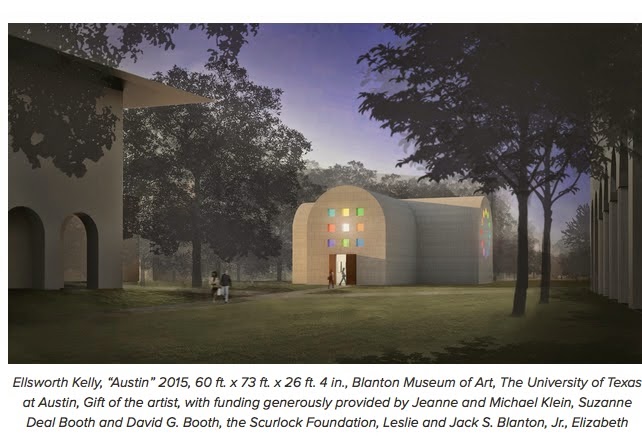
$15 million is the price tag to build the romanesque chaple on the University of Texas Austin campus designed by Ellsworth Kelly. $7 million has been raised; it will take a year to build when the $$ goal is met.

The structure looks a bit morrocan - 4 large segments form a rounded “x” shaped, modestly sized building(approx.2700 square feet).  Inside and outside surfaces are smooth and white broken only by contemporary slashes or dots of colored stained glass (the rose windows?) in 3 of the 4 chancels. A tall redwood totem stands in the 4th space and 14 black and white small marble panels hang uniformly around the walls. It appears that no seating is allowed...standing room only.?...or maybe kneeling room? Will Mr. Kelly (who is presently 92 I think) sign this artwork? Inside? outside? 


Sunday, February 10, 2013

The Southern Memory


Buildings tell the stories of our lives. 


Frank Poor taps into the nerve endings of nostalgia, mystery and memories with his architectural sculpture. Walking into the art gallery where his one man show is installed at Davidson College (Davidson, North Carolina)  is like walking into a room filled with ghosts and skeletons, the remnants of humble structures .

Poor is a southerner, born into the agriculturally based tradition of a small town in Georgia. He left the south in 1990, earned an MFA from Rhode Island School of Design in 1992 and stayed north for nearly twenty years. 

The south has a strong pull on its natives and like writers from the south, visual artists are usually gifted story tellers. Poor returned to Georgia and traveled across the blue highways of adjoining states to photographically document the fading architectural landscape - an assortment of decaying and falling-down barns, houses, churches. 

He printed his digital documentation onto transparencies. Then he built simple models of each building and “papered” the exterior wall, front and roofs with what look like negatives or x-rays. Most of the building/sculptures are roughly shoebox size and are attached to the walls of the all-white gallery.  Lighting from over head spots, slightly off-side, casts eerie shadows down the wall - explaining the show title: “Cast Shadows.”

The effect is instant and alarmingly visceral.  These places that once held everything important to multi-generations of people are now dying as we speak - abandoned by civilization that left them behind. Before much longer, weather and neglect will turn them into dust as surely as their former human occupants. 

(About thirty ago, I happened to walk into a major New York City museum where an entire room was filled with small detailed models documenting this similar slice of rural life. The artist was William Christenberry. I remember that experience in detail. I guess it combined the things closest to my heart: honest visual expression that tells a shared human story with incredible sensitivity, originality and a little humor.) 

Or maybe I just like small buildings. 

Tuesday, December 11, 2012


First, an oversight from my previous entry.

Portland, Oregon, painter Stephen O’Donnell is a very cool guy! Not only are his paintings beautifully executed, they spur a psychologically charged discussion that many people are afraid to broach: How do we identify ourselves? What do gender labels really mean? Do all women have male tendencies? As a male, is it o.k. to admit to certain feminine proclivities without being  homosexual? What exactly is transsexual anyway?

(Did I warn you? You might want to dial up Stephen’s paintings again. They are all self-portraits.)

``````````````````````````````````

For years, I have urged artists everywhere to leave their studios and look around at the world outside. I know you are busy…I don’t want you to waste your talent or energy. But you are a citizen and what happens in our cities (and Country) have huge impact on you as much as me and YOU HAVE SOME SPECIAL TALENTS THAT THE REST OF US NEED.

If there is remaining doubt about the cross-over of urban design, spend some time reading through the discussion of how a high rise multi-million dollar luxury condo is bringing the shadows of despair and death to a neighboring museum garden. Additionally, the reflected light from the tower has rendered a museum light installation unusable! Who would have guessed?

````````````````````````````````

Our home building project is still stuck in government and engineering limbo-land.  It’s just too boring to describe all the manholes we’ve fallen through.  The site is difficult for many reasons but let me warn everybody about one:  infill building!

You friends in Portland, Oregon, know all about infill building – channeling new construction into a crescent around metropolitan centers that already have the infrastructure, the rail lines, schools, etc. intact to support population growth and maintain virgin lands on the outskirts.  It’s a wonderful practice – hard to put into place politically, equally difficult practically.

Our 2.4 acres parcel is only three miles from the center of Rochester, New York. It has all the attributes attached to infill building plus it backs up to woods and trails that die into a large county park. It also comes with a full retinue of neighbors who really like their undeveloped private dumping ground! 

These people will be my neighbors one day. I can only hope the scars of battle will heal over before then.
Meanwhile, here is a picture of the building site and another of  one of my daughters, helping that day to clean out the barn.