Sunday, April 5, 2020

HISTORY: PART II

HISTORY IS HAPPENING: PART II
(A continuation of the Previous Blog Entry)


In the history of human development, economic inequality — the outrageous gap between the “haves and the have nots” — is shortened through one of four events.  They are:

  1. War
  2. Pandemic
  3. Revolution
  4. State Failure

This is the message at the heart of THE GREAT LEVERER written by Stanford historian Walter Scheidel and published in 2017.  He gives these examples.

The Black Plague resulted in labor shortages which forced raised wages and ultimately undermined the entire feudal system.

The U.S. Civil War abolished slavery (free labor) and gave rise to the 1862 Homestead Act. This legislation awarded 160 acres of publicly held land to any U.S. citizen or freed slave, age 21 or older. Ultimately 270 million acres were claimed and settled, giving rise toward U.S. middle class development.

World War I changed the role of women in world economies and paved the way for emancipation.

World War II elevated the role of labor unions in the U. S. and facilitated the creation of postwar welfare states in Europe and the National Health Services in Britain.

In an opinion piece written for The New Yorker, John Cassidy suggests that the current covid-19 pandemic will have consequences equally far reaching.  Our government has just passed a $2.2 trillion stimulus package — about 10% of American GDP and similar to one passed following the bombing of Pearl Harbor.  

Good idea? Poor use of funds? Too much given to one group and not enough to another? These things can be discussed but there is one certain fact: it was accomplished with head spinning speed during a time when party politics all but deadlocks passage of anything.

What’s to come next? Some form of medicare for all! Health services are already feeling the quakes of change. As medical delivery systems are drowning in efforts to keep up with virus demands, ordinary general health issues are being diagnosed via telemedicine. Where do doctor fees (and overhead) and insurance costs fit into that scenario?  Generations of debate about a U.S. national health system almost certainly will come to a head with this outbreak.

I may not live long enough to tract all the changes — and some surprising ones! —  resulting from “The Virus That Made the World Stop”…but changes there will be! 

Friday, April 3, 2020

HISTORY LIVED

One of many on-line games posted during the 2020 quarantine
Pay attention. History is happening.

If you are between ages 18 and dead, somebody someday will ask you about 2020 — that time when a virus shut down the world. How will you answer? You could begin with the affects of global warming. You could jump to the increasing denigration of science that led to nearly fatal skepticism of all factual evidence — especially in the United States. Maybe you want to talk a bit about disappearing boundaries — the nomadic lives and transit of goods on a planet shrunk down to the size of a grape. 

Or maybe you’ll simply shrug your shoulders and change the subject.

History is like this — day by day. While in the epicenter of events, no-one can predict how the course of human development — culturally, socially, politically, economically — could shift in totally unforeseen ways.  

My grandson called me from college one night. He had an assignment to interview someone of an “older generation” and ask “what was the greatest historic event that happened in your lifetime?” If you want to inspire interesting conversation around a dinner table, throw that challenge out and be surprised at the responses.

Clearly, some events have HISTORIC EVENT written in huge letters, i.e., the assassinations of world leaders, man’s landing on the moon, war — its beginning and its ending. But others creep into the spotlight only decades later. One man’s answer at my own dinner party was “invention and distribution of birth control pills. It radically changed the lives of women and expectations and definitions of marriage.” 

My older brother regrets that he never wrote a memoir and for good reason. He lived a unique story. He played a significant role in two wars — Korea and Viet Nam — and met with leaders who made decisions that had worldwide impact. But the memoir writing seemed an insurmountable job, a task woven into complicated political fabric, too complicated to pick apart. 

Many of us feel that our stories are not worth the telling. Memoirs, we believe, based on "best sellers," are written by people who survived extraordinary afflictions or addictions. Or those that won great acclaim, prizes, recognition. But the  stories that made Tom Brokaw’s book “The Greatest Generation” remarkable were those simple letters from regular young people written from foreign stations to their family or friends back home. The wonderful Ken Burns series about the Civil War soared not with the retelling of specific Civil War battles and the Gettysburg Address but those intimate details spliced together from “just folks” caught up in moments of history.

So, "just folks,” keep a diary. Write in a journal every now and then. Use your smart phone and record a snip of yours or someone else’s conversation. Take a photograph. There are millions — well, hundreds anyway — of ways to document your life. Don't tackle all 100 years. Talk about something today -- or this week -- a funny story or something poignant. 

The point is it’s your life. You are existing in a unique time and place. You have a view from your perch that nobody else has.   

It matters.

Sunday, March 22, 2020

ISOLATION

Quarantine, One week down.
Here is my week.

(How we all feel!)
  1. First Day: Shoppers are running out of stores with carts full of toilet paper and hand sanitizer. I can’t help wondering: why toilet paper? Is this a poop-flu? 
  2. Next day. Discount stores are out of all paper products. I’m glad I bought all those Ikea paper napkins. They’re totally versatile. 
  3. Day three. Still no paper goods but BJ’s has a full case of fresh vegetables that nobody wants. I predict people will die of scurvy.
  4. Todays news: the President has put his son-in-law as co-chair of the epidemic response team who then called his sister’s father-in-law to post on facebook “Any Ideas How to Curb This Thing?” The sister’s father-in-law is a doctor. I guess there’s some sense here but I thought the President “knew people.” I’m getting worried.
  5. I decided to make a big pot of stew. My daughter was going to the store and I asked her to pick up three  parsnips. She said they were all out. WHAT?! WHO BUYS PARSNIPS?! What a world!!! I packaged the stew into serving sizes and delivered one dinner size to my friend. Unfortunately, through a mix-up, I delivered the dog’s portion to her. Mistakes will be made. She ate it anyway.
  6. My husband is sanitizing everything he can find. His friend called and asked “Did you get the insides of the car door panels, windshield wipers, spare tire?”  I’m bored. He has cleaners’ elbow.
  7. I’ve worked the jigsaw puzzle and cleaned. I’ve had wine every night with dinner. Today I put on regular clothes and it wasn’t even noon yet. I’m ready for next week.

Quarantine, week two, begins today — Sunday, March 22. 

I can’t imagine how we get through many of these weeks.  Naturally, both dogs are sick and keep us up all night. They refuse their kibble unless it’s laced with a little cheese but outside? Deer poop? A delicacy!  

At 3 o’clock when rational thought disappears, I am convinced I have a developing brain tumor, stomach cancer, and another heart attack. I take a Tums, go to my computer and order a fun party game. 


Stay in touch, dear ones. Life doesn’t get much more interesting than this.
And it's only week #1!

Wednesday, February 26, 2020

ART CAN CHANGE THINGS

A scene from Academy Award winning South Korean movie "Parasite"
“Parasite” won the Academy Award for Best Picture of the Year, 2019.  It also won Best Director for South Korean film maker Bong Joon-Ho, and Best Screenplay, and Best Foreign Film.  

The movie is astonishing! First, the color saturation! Color is so intense that immediately you “get” that this is a fable. The setting is modern urban South Korea. When have you ever seen that on the big screen? For today’s wealthy Westerners, the movie focuses its lens on the squalid living circumstances of a poor city family (but the younger adults are all computer savvy — one of the many dichotomies of this place and era). But wait! Don’t feel sorry for this clan. They “work the system” — parasites. And they latch onto a rich family who live in bucolic modernity behind high walls just a few blocks away, insulated from the squalor— parasites in their own way.

Today, a news story reports that the South Korean government has passed a resolution to grant 3.2 million won (about $3000 in U.S.) to every urban household living in subterranean and semi-basement apartments. The grant is to improve heating systems, ventilation and replace floors, windows, and fire alarms.

The movie is directly responsible for that standard of living upgrade. The power of art. Is it the best way to form public policy? No, probably not, but wide spread public scrutiny cuts through a lot of red tape.

Art can zoom in on hard topics and sometimes, radically change public attitudes. Here’s a partial list of examples.

WEST SIDE STORY opened on Broadway in 1957, and was the first major musical to deal with the serious issues of gang violence, immigration, discrimination and police inadequacy to address changing mores. (It also happened to have a brilliant score and lyric…Leonard Bernstein and Stephen Sondheim!)

Part of the Keith Harding mural for "The Normal Heart"
THE NORMAL HEART, Larry Kramer’s play, opened in 1985. The set included posters and art by then-unknown pop artist Keith Harding. The topic was HIV-AIDS. This was at the beginning of the epidemic — the Reagan Administration was not responding to this health emergency.  The play and Harding’s popular posters and murals broke through the barriers between high and low art and poked a hole in the silence of these deaths.

Billie Holiday’s song “Strange Fruit” was recorded in 1939. The lyrics are about black lynching in America. The song became a global hit and helped launch the U.S. Civil Rights movement.

Pablo Picasso's "Guernica"
Pablo Picasso’s dramatic black and white mural “Guernica” was painted in 1937 to memorialize the 1930’s Spanish War. The painting illustrates the brutality and absurdity of war. It traveled throughout the world as part of the World’s Fair, crossing culture and linguistic barriers to carry the message globally.

Each of these examples relied heavily on a world stage from which to cast its message.  We sang a song in Sunday School when I was a child “this little light of mine, I’m gonna let it shine. Hide it under a bushel, NO…” 
````````````````````````````````````````

(A small commercial break: anyone interested in purchasing my book ART TALK…AND OTHER CONVERSATIONS can dial me up on Amazon Books. Price: $8.95. The book is an edited version of ten years go blogs — 2008 thru 2018. Thanks.) 


Friday, February 14, 2020

VALENTINE'S DAY AND NEW LOVE

"Ursula" by Bill Hastings
Meet Ursula. She’s about three feet tall and nearly as wide. She has very little face, poor thing, but hips to die for. 

All those petals forming her exterior were once shiny. She’s aged a bit in nearly twenty years. But age has been kind to Ursula. The obnoxious glint of youth mellowed into a lovely multi-hued coat of lavenders, blues and grays with just a smidge of glint. 

It’s very tasteful. 

Ursula doesn’t run. Those little legs are sturdy enough to hold her upright but couldn’t possibly stretch out into anything like a trot never mind a full-out run. She has small toy wheels standing in (excuse the pun) for feet. Poor Ursula. What happened to her feet? For that matter, what happened to her face? Is Ursula a laboratory clone that went bad? Ursula is much more seductive from the backside than from the front. I wonder if it’s the same for me? I can’t actually see my backside but I’m pretty sure it isn’t nearly as curvy as Ursula’s.

Let’s take a minute and give thanks for wheels.  Ursula’s wheels are charming and sweet and transform an almost-animal into a toy. All she needs is a cool necklace with a long string attached. With that, some kid could drag poor Ursula around the block. I never actually understood the pleasure of dragging around a toy.  My own children totally ignored pull toys. I give them a lot of credit for showing good sense at an early age.

But wait a minute! Wheels play a big part in war too! Tanks! The Trojan Horse! Caissons go rolling along.  And Ursula has that full metal jacket. Ursula is not as innocent as she first seemed. Ursula could be an agent of war! 

I have the Trojan Sheep coming to live in my living room!

Ursula sprang from the imagination and hands of Bill Hastings who teaches art at Ithaca College.  I saw Ursula in an exhibit in the early 2000s. Mr. Hastings was new in town. I became somewhat obsessed with Ursula and corresponded with Mr. Hastings once or twice over the years. (Ursula lived in his barn.) Finally, a month or two ago, I decided that Ursula needed to come live with me.

In about two weeks, I’m giving a talk in Pittsford about collecting art. I don’t really have much to say on the subject. Except this: look at a lot of art. Go back sometimes, and look at the same thing more than once. Think carefully. Things in our surroundings own a piece of us. What are you willing to make space for? 

Sometimes, you maybe can make those decisions instantly but at others, time is your friend. Contact artists. They want to know you still remember something they made and put out there even if the “something” is gone.

On this Valentine’s Day, it maybe isn’t too late to express a long, lost love. You might get your Ursula.


Friday, February 7, 2020

MEMOIR; THE EARLY YEARS

February 7, 2020 - my back yard
It never snowed in Oklahoma when I was a kid. But once — I must have been four or five years old — we had a massive ice storm. A willow tree stood a few feet from our house, odd now that I think of a willow tree growing in that dry, played out soil — the same tree that donated supple branches that Mom used now and then to whip across the backs of our legs in punishment. “A switching.” That’s what she called it but like any whip, the result was the same: stinging, stinging, burning, thin raised red welts on the backs of tanned bare legs. As my memory spools back on those days, I reach my calves to rub away the pain, seventy years later. 

That morning, incased in inches of ice, the willow morphed into one of those clear glass trees — the kind we watched a man with a blow torch make at the State Fair — “lamp work,” the technique I’ve since learned to name. Not only the tree but the entire universe outside our door looked clean and shiny and impossibly alien.  

Pauline, a friend of my older sister, came skidding down the middle of our street on ice skates. It never occurred to any of us to wonder how Pauline, a teen ager growing up in the Dust Bowl, happened to own ice skates, just waiting in back of her closet for just such event as this natural ice arena. That she could actually use them is as great a mystery. Watching her, I couldn’t wait to put on boots and try that slide-walk. 

Boots. We called galoshes. Mine were red. Rubber high top overshoes that were the devil to get on and off even with the Wonder Bread plastic bags we put over our inside shoes first. Galoshes were designed for rain. Or maybe dirt. With no bottom tread, they were not so good for ice but that’s what we had. Not skates. Not those special lace up pure white Cinderella slippers with impossibly thin blades on the bottom that let you whoosh across the road’s glassy surface. 

Maybe it didn’t really matter; the ice melted with an afternoon sun. But for that morning, it mattered to my sister. She watched Pauline, floating down the street, like I watched older kids who had bikes, innately knowing that with wheels and gears came the twins: freedom and independence.  


February 7, 2020


Wednesday, January 15, 2020

BIRTHDAYS AND EYE CANDY

When I turned 70, I cried for a year. 

For one thing, I thought I’d be dead by then, but VOILA! I woke up still breathing and big as Dallas, staring out at people and the world. Nothing was transformed from the day or year before except that I was officially “an elder.” 

Magazines and advertisers try to convince us that 70 is the new 60.  WTF! When did 60 get to be so great? At 64, I thought my life was pretty much Cream of Wheat. That’s when I began writing this blog. No, the blog has not magically changed my life. But it has provided me with a great outlet for talking about observations and commenting on the purely laughable state of human beings -- me included..

I stopped crying when I turned 71. I can’t remember why; it was a sudden flash of optimism. Maybe it was acceptance. Whatever it was, now I think deeper thoughts, feel with greater empathy, and form more profound questions. 

Maybe I had a stroke. 

(Nobody told me and I can decide right now whether to believe or not believe whatever I chose. It’s the new rage: it’s called picking facts that I like.)

Today I am 76 and celebrating my birthday in North Carolina. Last night, I read a few blog entries to a group of lovely ladies at The Pines, a very posh elder residency. I picked an entry from 10 years back that begins “I have been obsessing about death and dying lately.” I looked out over these 20 or so bodies and thought “what in hell can I tell this group and how can I make a joke about dying?” But I did…and they laughed. These women are survivors. And I decided, o.k. Game on! 

I like that part about myself. The rest of me could use a good wire brushing and a new paint job.

Elizabeth Strout in her new book “Olive, Again” moves Olive to assisted living. Now Olive is in her mid-80s and she sits down to type her memoirs. After a few minutes, she types “I do not have a clue who I have been.  Truthfully, I do not understand a thing.”  

Isn’t that just the best?


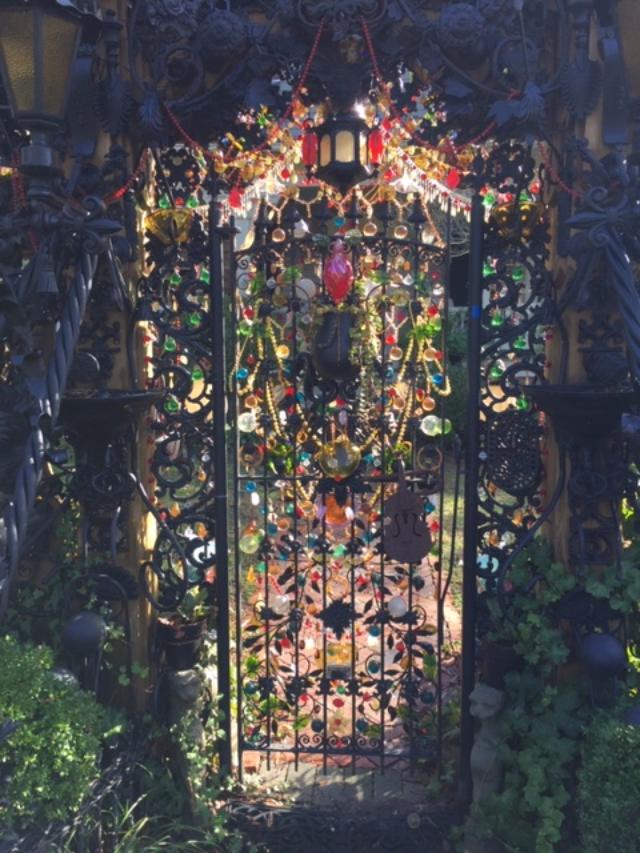
DETAIL -iron gate decorated with found material...the home of a graphic designer and his artist-wife.