Sunday, March 22, 2020

ISOLATION

Quarantine, One week down.
Here is my week.

(How we all feel!)
  1. First Day: Shoppers are running out of stores with carts full of toilet paper and hand sanitizer. I can’t help wondering: why toilet paper? Is this a poop-flu? 
  2. Next day. Discount stores are out of all paper products. I’m glad I bought all those Ikea paper napkins. They’re totally versatile. 
  3. Day three. Still no paper goods but BJ’s has a full case of fresh vegetables that nobody wants. I predict people will die of scurvy.
  4. Todays news: the President has put his son-in-law as co-chair of the epidemic response team who then called his sister’s father-in-law to post on facebook “Any Ideas How to Curb This Thing?” The sister’s father-in-law is a doctor. I guess there’s some sense here but I thought the President “knew people.” I’m getting worried.
  5. I decided to make a big pot of stew. My daughter was going to the store and I asked her to pick up three  parsnips. She said they were all out. WHAT?! WHO BUYS PARSNIPS?! What a world!!! I packaged the stew into serving sizes and delivered one dinner size to my friend. Unfortunately, through a mix-up, I delivered the dog’s portion to her. Mistakes will be made. She ate it anyway.
  6. My husband is sanitizing everything he can find. His friend called and asked “Did you get the insides of the car door panels, windshield wipers, spare tire?”  I’m bored. He has cleaners’ elbow.
  7. I’ve worked the jigsaw puzzle and cleaned. I’ve had wine every night with dinner. Today I put on regular clothes and it wasn’t even noon yet. I’m ready for next week.

Quarantine, week two, begins today — Sunday, March 22. 

I can’t imagine how we get through many of these weeks.  Naturally, both dogs are sick and keep us up all night. They refuse their kibble unless it’s laced with a little cheese but outside? Deer poop? A delicacy!  

At 3 o’clock when rational thought disappears, I am convinced I have a developing brain tumor, stomach cancer, and another heart attack. I take a Tums, go to my computer and order a fun party game. 


Stay in touch, dear ones. Life doesn’t get much more interesting than this.
And it's only week #1!

Wednesday, February 26, 2020

ART CAN CHANGE THINGS

A scene from Academy Award winning South Korean movie "Parasite"
“Parasite” won the Academy Award for Best Picture of the Year, 2019.  It also won Best Director for South Korean film maker Bong Joon-Ho, and Best Screenplay, and Best Foreign Film.  

The movie is astonishing! First, the color saturation! Color is so intense that immediately you “get” that this is a fable. The setting is modern urban South Korea. When have you ever seen that on the big screen? For today’s wealthy Westerners, the movie focuses its lens on the squalid living circumstances of a poor city family (but the younger adults are all computer savvy — one of the many dichotomies of this place and era). But wait! Don’t feel sorry for this clan. They “work the system” — parasites. And they latch onto a rich family who live in bucolic modernity behind high walls just a few blocks away, insulated from the squalor— parasites in their own way.

Today, a news story reports that the South Korean government has passed a resolution to grant 3.2 million won (about $3000 in U.S.) to every urban household living in subterranean and semi-basement apartments. The grant is to improve heating systems, ventilation and replace floors, windows, and fire alarms.

The movie is directly responsible for that standard of living upgrade. The power of art. Is it the best way to form public policy? No, probably not, but wide spread public scrutiny cuts through a lot of red tape.

Art can zoom in on hard topics and sometimes, radically change public attitudes. Here’s a partial list of examples.

WEST SIDE STORY opened on Broadway in 1957, and was the first major musical to deal with the serious issues of gang violence, immigration, discrimination and police inadequacy to address changing mores. (It also happened to have a brilliant score and lyric…Leonard Bernstein and Stephen Sondheim!)

Part of the Keith Harding mural for "The Normal Heart"
THE NORMAL HEART, Larry Kramer’s play, opened in 1985. The set included posters and art by then-unknown pop artist Keith Harding. The topic was HIV-AIDS. This was at the beginning of the epidemic — the Reagan Administration was not responding to this health emergency.  The play and Harding’s popular posters and murals broke through the barriers between high and low art and poked a hole in the silence of these deaths.

Billie Holiday’s song “Strange Fruit” was recorded in 1939. The lyrics are about black lynching in America. The song became a global hit and helped launch the U.S. Civil Rights movement.

Pablo Picasso's "Guernica"
Pablo Picasso’s dramatic black and white mural “Guernica” was painted in 1937 to memorialize the 1930’s Spanish War. The painting illustrates the brutality and absurdity of war. It traveled throughout the world as part of the World’s Fair, crossing culture and linguistic barriers to carry the message globally.

Each of these examples relied heavily on a world stage from which to cast its message.  We sang a song in Sunday School when I was a child “this little light of mine, I’m gonna let it shine. Hide it under a bushel, NO…” 
````````````````````````````````````````

(A small commercial break: anyone interested in purchasing my book ART TALK…AND OTHER CONVERSATIONS can dial me up on Amazon Books. Price: $8.95. The book is an edited version of ten years go blogs — 2008 thru 2018. Thanks.) 


Friday, February 14, 2020

VALENTINE'S DAY AND NEW LOVE

"Ursula" by Bill Hastings
Meet Ursula. She’s about three feet tall and nearly as wide. She has very little face, poor thing, but hips to die for. 

All those petals forming her exterior were once shiny. She’s aged a bit in nearly twenty years. But age has been kind to Ursula. The obnoxious glint of youth mellowed into a lovely multi-hued coat of lavenders, blues and grays with just a smidge of glint. 

It’s very tasteful. 

Ursula doesn’t run. Those little legs are sturdy enough to hold her upright but couldn’t possibly stretch out into anything like a trot never mind a full-out run. She has small toy wheels standing in (excuse the pun) for feet. Poor Ursula. What happened to her feet? For that matter, what happened to her face? Is Ursula a laboratory clone that went bad? Ursula is much more seductive from the backside than from the front. I wonder if it’s the same for me? I can’t actually see my backside but I’m pretty sure it isn’t nearly as curvy as Ursula’s.

Let’s take a minute and give thanks for wheels.  Ursula’s wheels are charming and sweet and transform an almost-animal into a toy. All she needs is a cool necklace with a long string attached. With that, some kid could drag poor Ursula around the block. I never actually understood the pleasure of dragging around a toy.  My own children totally ignored pull toys. I give them a lot of credit for showing good sense at an early age.

But wait a minute! Wheels play a big part in war too! Tanks! The Trojan Horse! Caissons go rolling along.  And Ursula has that full metal jacket. Ursula is not as innocent as she first seemed. Ursula could be an agent of war! 

I have the Trojan Sheep coming to live in my living room!

Ursula sprang from the imagination and hands of Bill Hastings who teaches art at Ithaca College.  I saw Ursula in an exhibit in the early 2000s. Mr. Hastings was new in town. I became somewhat obsessed with Ursula and corresponded with Mr. Hastings once or twice over the years. (Ursula lived in his barn.) Finally, a month or two ago, I decided that Ursula needed to come live with me.

In about two weeks, I’m giving a talk in Pittsford about collecting art. I don’t really have much to say on the subject. Except this: look at a lot of art. Go back sometimes, and look at the same thing more than once. Think carefully. Things in our surroundings own a piece of us. What are you willing to make space for? 

Sometimes, you maybe can make those decisions instantly but at others, time is your friend. Contact artists. They want to know you still remember something they made and put out there even if the “something” is gone.

On this Valentine’s Day, it maybe isn’t too late to express a long, lost love. You might get your Ursula.


Friday, February 7, 2020

MEMOIR; THE EARLY YEARS

February 7, 2020 - my back yard
It never snowed in Oklahoma when I was a kid. But once — I must have been four or five years old — we had a massive ice storm. A willow tree stood a few feet from our house, odd now that I think of a willow tree growing in that dry, played out soil — the same tree that donated supple branches that Mom used now and then to whip across the backs of our legs in punishment. “A switching.” That’s what she called it but like any whip, the result was the same: stinging, stinging, burning, thin raised red welts on the backs of tanned bare legs. As my memory spools back on those days, I reach my calves to rub away the pain, seventy years later. 

That morning, incased in inches of ice, the willow morphed into one of those clear glass trees — the kind we watched a man with a blow torch make at the State Fair — “lamp work,” the technique I’ve since learned to name. Not only the tree but the entire universe outside our door looked clean and shiny and impossibly alien.  

Pauline, a friend of my older sister, came skidding down the middle of our street on ice skates. It never occurred to any of us to wonder how Pauline, a teen ager growing up in the Dust Bowl, happened to own ice skates, just waiting in back of her closet for just such event as this natural ice arena. That she could actually use them is as great a mystery. Watching her, I couldn’t wait to put on boots and try that slide-walk. 

Boots. We called galoshes. Mine were red. Rubber high top overshoes that were the devil to get on and off even with the Wonder Bread plastic bags we put over our inside shoes first. Galoshes were designed for rain. Or maybe dirt. With no bottom tread, they were not so good for ice but that’s what we had. Not skates. Not those special lace up pure white Cinderella slippers with impossibly thin blades on the bottom that let you whoosh across the road’s glassy surface. 

Maybe it didn’t really matter; the ice melted with an afternoon sun. But for that morning, it mattered to my sister. She watched Pauline, floating down the street, like I watched older kids who had bikes, innately knowing that with wheels and gears came the twins: freedom and independence.  


February 7, 2020


Wednesday, January 15, 2020

BIRTHDAYS AND EYE CANDY

When I turned 70, I cried for a year. 

For one thing, I thought I’d be dead by then, but VOILA! I woke up still breathing and big as Dallas, staring out at people and the world. Nothing was transformed from the day or year before except that I was officially “an elder.” 

Magazines and advertisers try to convince us that 70 is the new 60.  WTF! When did 60 get to be so great? At 64, I thought my life was pretty much Cream of Wheat. That’s when I began writing this blog. No, the blog has not magically changed my life. But it has provided me with a great outlet for talking about observations and commenting on the purely laughable state of human beings -- me included..

I stopped crying when I turned 71. I can’t remember why; it was a sudden flash of optimism. Maybe it was acceptance. Whatever it was, now I think deeper thoughts, feel with greater empathy, and form more profound questions. 

Maybe I had a stroke. 

(Nobody told me and I can decide right now whether to believe or not believe whatever I chose. It’s the new rage: it’s called picking facts that I like.)

Today I am 76 and celebrating my birthday in North Carolina. Last night, I read a few blog entries to a group of lovely ladies at The Pines, a very posh elder residency. I picked an entry from 10 years back that begins “I have been obsessing about death and dying lately.” I looked out over these 20 or so bodies and thought “what in hell can I tell this group and how can I make a joke about dying?” But I did…and they laughed. These women are survivors. And I decided, o.k. Game on! 

I like that part about myself. The rest of me could use a good wire brushing and a new paint job.

Elizabeth Strout in her new book “Olive, Again” moves Olive to assisted living. Now Olive is in her mid-80s and she sits down to type her memoirs. After a few minutes, she types “I do not have a clue who I have been.  Truthfully, I do not understand a thing.”  

Isn’t that just the best?


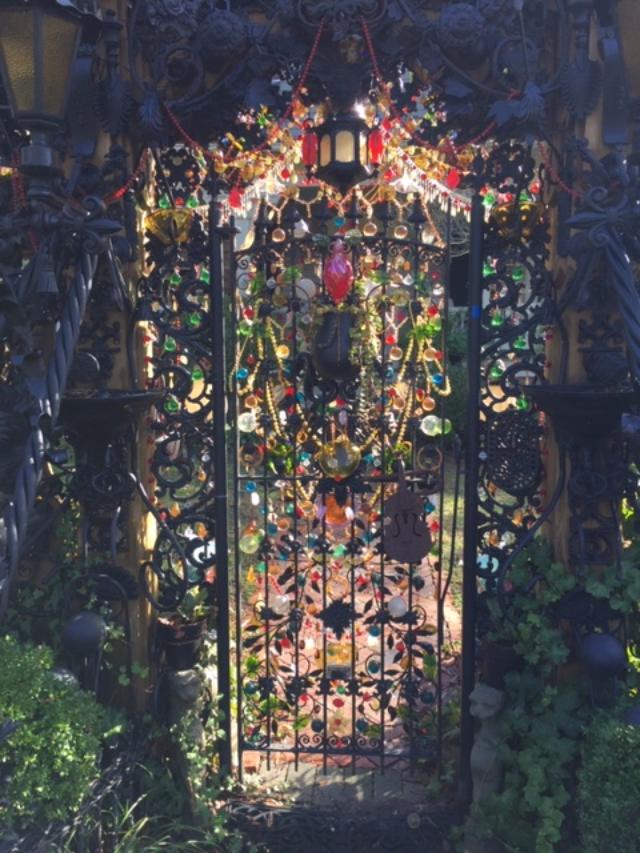
DETAIL -iron gate decorated with found material...the home of a graphic designer and his artist-wife.

Thursday, December 12, 2019

IN DEFENSE OF BANANAS


“With a Historic Splash, David Hockney Becomes the World’s Priciest Living Artist”…$358 million for one painting : 2018

“Leonardo da Vinci Painting Sells for $450 million” (2017)

Two art auction headlines. 
They came and went and nobody batted an eye. 
People assumed that a da Vinci is worth $450 million because after all, he’s dead, and he’s in all the art history books. 
The David Hockney thing raised a few eyebrows because, after all,  he’s still alive.  

Think about those amounts of money. Nearly half a billion dollars — sales to individuals — not museums, not governments. In a world where individuals have billions of dollars to spend on ANY object, is monetary value meaningless?

 “It’s all hokum, sleight of hand, gas and mirrors!” That was Marcel Duchamp (1917) when he entered a urinal as art object at the Society of Independent Artists.  He justified his action with “it is art because I am an artist and I say it is” — the audacity of his “brutal sneer.” 

Almost everybody knows about the urinal but what was Duchamp trying to tell us? I believe it is that art is everything no matter what title you give it — painting, sculpture, egg turner, shovel. If we are to live our lives to the fullest, then we must look at everything we see and touch as “art.”

Well! That gets to be pretty exhausting, don’t you think? Much easier to establish categories. So shovels go into “house goods”. Buy those at the hardware store. Art belongs in museums…or in hands of very wealthy people. And that, dear readers, is totally against Duchamp’s lesson. 

Artists regularly remind us of Duchamp’s philosophy because we can’t seem to get it:  art permeates everything and belongs to everyone. Enter the banana taped to a wall (2019). Title: The Comedian. Artist: Maurizio Cattelan, the same conceptual artist who created the 18 carat gold toilet (Title: America). Mr. Cattelan is not very subtle in his “brutal sneers.”  

For a few minutes last week, everybody was talking about the $120,000 banana. Question: who is the comedian of the title? the artist? the art bureaucracy that willingly exhibited the piece in a major international show? the buyer? Or billionaires (and by extension, all of us) chasing validation and prestige through accumulation of things? 

Art isn’t alone in this skewed value system. In what universe is a baseball player’s employment worth $324 million (9 year contract?) How can anybody even talk about a $24,000 hair cut? Or a $300 million car collection?  How about a 27 story apartment for $1 billion (a part time residence)?  Or a $1.5 Million i phone? (Each of these is actual fact verified by a ten second Google search.)

We are immune to such outrageous extravagance. But tape a banana to a wall, and it’s a new kind of crazy. 

Or it's really, really funny.


Saturday, December 7, 2019

CONFESSIONS OF A HOLIDAY SHOPPER

My "Holiday Blouse"
I just ordered this expensive blouse from an English catalog. It’s being delivered in 12 hours.  That’s the power of internet shopping. I can’t drive from my house to the nearest shopping mall, park, walk inside, find something, purchase, bring home, try on, reverse all…in less than double the time.  Shipping from England: $15 — a bargain.

Not to say this blouse has staying power. Already I'm thinking “big flowers?” I’m old — and “chubby” — and 5’2”(down from 5'3). Then there’s the issue of European sizing. I either ordered a size big enough to serve as Tyvek on the garage or one that will fit my terrier, Lucy. I filled out the “size chart” questionnaire: Height: 5’6,” Weight: 122 lbs., Age: 43. Then I sized up a notch and figured “close enough.”

Now I’m on the hunt for velvet pants. In my dream, I will be transformed into the twin of this model — not outrageously glamorous, not movie star beautiful. This lady looks more like a nurse practitioner or maybe a cellist. I want to be her.

My friend asked me “why velvet pants?” I said “for holiday parties.” “Exactly how many holiday parties are you going to?” That’s when I confronted the awful truth: I’m not going to any holiday parties. 

What am I thinking? I just went through a cleanse. I just wrote about the weight of too much — and I believe every word! But I suffer from the curse of being a middle class American woman, brain washed into thinking I can be younger, prettier, thinner, smarter if I only have the right outfit. Like that song about Laredo: “if you have an outfit you can be a cowboy too.” With the right velvet pants, maybe I can play the cello…or dance a wicked tango…or understand Italian…

``````````````````````````````````````````````````````````````
Political Conservatives are on the march again: the multi-trillion dollar federal deficit needs trimming, so by all means, cut the few pennies thrown at the National Endowment for the Arts. Easy target! Read Eve L. Ewing, a sociologist at the University of Chicago, writing for the New York Times. She builds a persuasive case:  Art becomes a political target because it creates pathways to subversion, and incites political understanding and solidarity among coalition builders.  If that’s not enough reason to “throw those artists and performers and writers in the klink,” this one is: ART TEACHES THAT ALL LIVES HAVE VALUE. 

Happy December, everybody.