Wednesday, September 2, 2015

A VACATION RENTAL RANT

A VACATION RENTAL RANT

I don’t know about you but I would try one of those “house swap” vacations, the kind where you leave your car, your cat and house keys totally in the hands of strangers who live on another continent and they do the same thing and you board a plane, find the environment to refresh your soul and meet whatever amazing adventures undoubtedly await.  What could go wrong?

It works in the movies. Didn’t everybody see that movie with Jude Law and whoever those women were? one who lived in a $15 million mansion in the Hollywood Hills and the other in a thatch roofed Cotswold cottage in snowy England?  That went perfectly for EVERYBODY even Jack Black (!) who got to kiss and woe Kate Winslet,  heretofore considered beautiful and SENSIBLE.

But what happens in the movies, stays in the movies. Real life vacation rentals - and I’ve known more than my share - are rarely as advertised and I and my husband just got home from another week spent in something called an efficiency condo on the grounds of Chautauqua Institution. 

Chautuaqua is what I describe as “Disneyland for Discerning Adults,” built on the shores of Chautauqua Lake and chock-a-block with intellectual courses, lectures and entertainment. It’s expensive. There’s a one time charge for a gate pass (something around $500 per person per week) and a parking pass (another hundred). Most “events” are free but not all. And then there’s the cost of accommodation rental.  

We paid $120 per night for a space approximately 10 feet wide and 18 feet long. A bathroom, kitchen and closet came off one end. The bed folded into the wall and sliding doors opened onto a small balcony on the other end. No maid service - no fresh towels every day - and as it turned out, no soap or shampoo included. The building did include WiFi and a flat screen t.v. that received 7 channels - 4 of which were National Public Broadcast and 1 twenty-four hour news and weather.

It also included….. 
27 threadbare towels
14 placemats
6 blankets/bedspreads
8 pot holders
china and flatware, complete setting for 12
enough serving pieces for Thanksgiving dinner
several drawers full of wires, remotes and misc. electronic stuff
2 vacuum cleaners
a kitchen cabinet filled with coffee mugs (but no juice glasses)

So here’s the thing: I understand that you landlords will charge as much money as you can but please, could you at least buy a couple of fresh towels and maybe sheets made after 2000? maybe put all your personal junk in one drawer somewhere so that I have space for my week’s worth of undies? And when did you last need baking dishes, serving platters, 2 massive barcaloungers, a desk and chair, a table and two chairs, a loveseat, coffee table and folding chairs? What kind of parties do you throw anyway? 

I just want a decent juice glass and a towel that doesn’t take my hide off! When I trade houses, I’ll ask more questions.

````````````````````

We met a really interesting couple in Asheville,NY. Vince builds skyscrapers Monday through Friday but on week ends, he welds rusty found garbage into yard art. He says “To invent, all you need is a little creativity and a good junk pile.” 


Wednesday, August 19, 2015

THE PROBLEM OF FOLK ART

TO PROTEST OR NOT TO PROTEST, THAT IS THE QUESTION


I grew up in total racial segregation. No one in my immediate world talked about blacks because we were too poor to hire them and so, with nearly complete segregation, they simply didn’t exist except in the movies.  

I don’t remember my parents being particularly interested in race one way or another. Mom never said anything about people of color that I ever heard. Dad was surely racist but he had tremendous admiration for athletes and musicians and on those playing fields, he was totally color blind.

I never heard of the 1920 Tulsa Greenwood Riots until about 20 years ago. 

Detailed events are explained on several web sites. But here’s the short version:

There existed in Tulsa, Oklahoma, a black neighborhood of more than 2000 homes and business. It was called the “Black Wall Street.” Greenwood was one of the wealthiest black communities in the United State. Because of segregation, it encapsulated a city within a city - retail stores, banks, a hospital, school system -  and it’s inhabitants worked in “service” to the white community but also they included the professionals that served their own.

A 19 year old black boy whose grandparents lived in Greenwood was accused of “assaulting” a white girl in a downtown office building and on very shaky evidence, was arrested for the crime. One of Tulsa’s sensationalist newspapers reported the crime the following day with blazing headlines and used the L-word: “lynch.” 

What followed were a series of missteps that erupted in an invasion of Greenwood by thousands of whites on foot, in cars and via private airplanes (!)  indiscriminately shooting and setting fires. When trouble first began and blacks called Tulsa police for help they were told that the police were busy on other calls. The State police finally arrived and eyewitnesses claim they joined the white rampage.

Estimates of deaths range from a few dozen to thousands. Blacks were driven from their homes and when the smoke and noise died down, as many as 5000 survivors were rounded up and held in detention centers while looters and vandals finished off Greenwood, stealing whatever was worth taking and setting fire to everything else. When mayhem abated, to make certain that Greenwood was really dead, the entire area was rezoned “commercial” - no housing allowed.

And that was the end of the story - no one EVER talked about it. But in 1996, the 75th anniversary of Greenwood, the incident was reported in the Tulsa World with interviews by several elderly survivors. Shining a light on the abomination led to a State investigation commission that reported full findings in 2001. 

I wish I could say that what happened next was a wonderful example of racial healing and reparation.  But I can’t. 300 college scholarships were set aside for Greenwood descendants.  A historic marker was installed in Tulsa and a memorial park built. The neighborhood isn’t too far away from University of Tulsa; today it looks like a cleaned-up university city project including a pretty little park. I don’t know where black people live in Tulsa but it is NOT Greenwood.  

Now we in Rochester are debating a couple of 100 year old paintings on a carousel. Really? Folk art is never politically correct so do we erase it all? Put it all in a glass case somewhere (where elitists have greatest access)?  What about other art expressions? Movies…Shirley Temple tap dancing with Bo Jangles? What to do? Atlanta burning while “I don’t know nothin’ about birthin’ no babies!” The words in “ShowBoat” - a historical lynchpin in stage musicals - have been changed - several times! - to make them acceptable via today’s standards and the power of the original is diminished.

I am overwhelmed by the inhumanity perpetrated in my home town but my current home town has long-standing, alarming injustices.  A couple of 100 year old paintings on a carousel don’t begin to touch the conversation we should be having.


Saturday, August 8, 2015

A Little Late Night Musing (And By the Way, I Hope Elaine Is a Good Sport.)

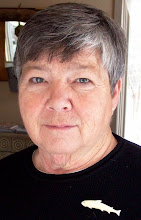
This is a photograph of Elaine Lennox. I’m not too sure that I know her but somehow we must be “facebook friends” because I open facebook and there she is with photographs of herself smiling in front of all kinds of backgrounds. Sometimes she’s with other smiling people. 

Below her pictures, friends write little messages to Elaine and I don’t seem to know any of these people either; they write about things and places and all I can do is shrug my shoulders.  This happens to me a lot on facebook. 

One of her facebook friends asks if this picture was taken in Cleveland. Why? I know that Elaine lives in Rochester but does she spend a lot of time in Cleveland? Or did she take a trip there recently? Good lord, I hope it wasn’t health related!  You know, Cleveland Clinic and all. Poor Elaine.   

Maybe Elaine has relatives who live there…grandchildren even. I have a real live friend who has grandchildren in Cleveland that she visits all the time but she never posts interesting pictures of anything on facebook - not even pictures of her grandchildren and certainly no pictures of herself even if she did happen to stand in front of a wall covered in writing.

But maybe my friend hasn’t come across THIS wall yet.This happens to be a way cool wall. This is what we could call an inter-active wall because who wouldn’t want to add to the sentence “I want to…”

How cool would it be to take time-lapse photographs of this wall as it fills with all kinds of writing? Or even better, hide in a bush and if a little kid writes “….go to the zoo” (for instance), you could jump out of the bush and say “This is your lucky day! I’m taking you to the zoo!” 

Or maybe rich people in the community could take turns making wishes come true from the wall but somebody else would need to hide in the bushes. I’m pretty sure rich people wouldn't want to do that part.  So you’d need a hidden camera somewhere; these things could be worked out.

Before we go any further with this wall thing, there’s bound to be somebody who said “what do we do about INAPPROPRIATE writing on the wall?” to which I think you just need to retort (don’t you love “retort?”) “There’s ALREADY inappropriate things written on walls in this city…maybe in this very neighborhood. Don’t sweat it.” 

(Unless what’s written is violent in which case it’ll all be on camera and the police can grab the miserable bastard but I hope they don't shoot the person. People are getting shot for less you know.) 

The bigger problem: where do you keep the chalk?

If I ever meet Elaine Lennox, first I’ll say “I hope you’re feeling better.” Then I’ll ask her did she write something on the wall?  


Maybe she can tell me where they kept the chalk.

Tuesday, July 28, 2015

TRASH

History is written in trash. Somebody somewhere is always digging up something that opens new rounds of discussion: who were these people? what went on here? why? what? who? where? when?  We are endlessly fascinated by…ourselves. That, after all, is the seed of the real question. Why am I here? What role am I supposed to play? How do I know if I’m doing it right? What is RIGHT? What happens to me at the end? Will I matter?
.
Finding a few bones and shards of pottery? Answers? Hardly!  I can’t imagine a single thing that I leave behind that will enlighten anybody hoping to fill in the blanks of my story…except words. Is that why I write? Yes. It really is as simple as that. I write because I want somebody else to know that I loved to watch birds, that I find pure magic in unexpected beauty manmade or otherwise, that “numinous” is my favorite word, and when I come back to earth for a second go-round, if I’m not a nightclub chanteuse I will be completely pissed off. 

Meanwhile, about that trash.  The burden of being a rich nation is that we have it…and need to hide it somewhere. Fort Bragg, California, decided to designate part of their ocean beachfront as “The Dump.” It was 1906, long before ocean beachfront was measured in dollar sign per foot. 

By 1943, Site #1 was filled. Onward to Site #2 (1943-1949)  and Site #3. The whole place was finally shut down before 1970. Much of the bulk had biodegraded by then. Metal was sold for scrap or to those nutty artists. What remained was glass, glass that was tumbled smooth by ever-present ocean waves.

By 1998, the beaches were made up nearly entirely by glass and the private owner decided Glass Beach should belong to the State of California and sold all 38 acres through the California Coastal Conservancy.

1000 to 12,000 visitors stop by daily to admire Glass Beach.  Some come with buckets to take sea glass away but that’s become illegal so don’t do it. Regardless, the glass is disappearing.  Those waves keep breaking the trash down into tiny bits of….sand. 


Hmmm…

Friday, July 3, 2015

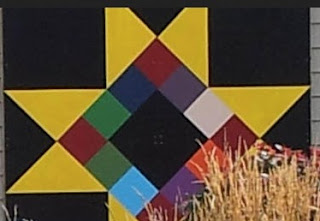
PS - BARN QUILT SIGNS

This will be brief!

I bought my MDO at Rochester Lumber. Now to cut it into 3 ft. squares, the size I think best for my barn.

Next comes exterior primer on ALL SIDES INCLUDING EDGES.

Finally, deciding and painting the design in exterior paint. Since my barn was part of a dairy farm in the 1800's, I'm thinking "cows."

If you looked at the map of New York, you noticed that Monroe County does NOT have a "barn quilt trail" and it seems to me that should be "fixed."  Initiating a barn quilt trail program is actually pretty easy, does not require the art council to put $$$ upfront and is a terrific "attention getter" for both the art councils and tourist bureaus...with or without additional investment in marketing.

I sent an email to the Monroe County Arts and Culture Council to suggest the above....no response. If ANYBODY OUT THERE IS READING THIS, perhaps you could follow up? After all, don't we all need another quilt in our dull Upstate winters?

Monday, June 29, 2015

THE (barn) QUILT TRAIL

Donna Sue Groves wanted to surprise and honor her mother, Maxine. Maxine was an avid and somewhat well-known quilter so Donna Sue decided to paint a large quilt square on wood and install it on the family barn.  The family barn - and family - resided in Adams County, Ohio, and this was 2001. It was also the beginning of a “Quilt Trail” with tributaries now in 43 United States and 2 Canadian Provinces.

Decorating barns is not new. Barns mostly were unpainted until the mid-1800’s. By 1850, paint was affordable and easy to come by and Pa. Dutch had a heritage of painting on just about everything! It didn’t take a huge leap from painting red barns to jazzing them up with a big ol’ garnishes that came to be called “hex signs.” 

Hex signs were generally stars, triangles and flowers inside circles and there’s a bunch of theory as to their meanings, most commonly something about superstition, but those theories are all merely guesswork.  

Two important things happened to set them in front of the american folk art eye: Pennsylvania Dutch farms were/are among the tidiest communities in our Country . They are simply beautiful and happened to be set among the rolling hills of Pennsylvania, itself a lovely part of our nation. These communities were stamped with every attribute we associate with agricultural/societal perfection and populated by equally perfect people: clean, self-reliant, creative, nurturing, and successful but humble. The combination made this a microcosm so foreign to the rest of us (Disneyland hadn’t been invented yet) that it became a tourist destination and wham-o!, (2) an enterprising speculator started selling hex signs as souvenirs.

I first came across Quilt Trails in North Carolina and jumped to the obvious (and wrong!) conclusion that North Carolinians were especially clever when it comes to crafts and how to market them. We began seeing squares on barns when we visited Penland. N.C. still holds a special place in my estimation; you can actually pick up tourist maps at any N.C. visitor center to follow barn trails. Digging a little further, I came across a web site for Ontario, Canada, where they hold workshops where you can design and paint your own squares and spares for people who agree to install but don’t want the dirty work.

Here’s a map of New York with counties that have quilt trails.  Just like us Yankees, however, nobody seems to know how to put it all together in a tourist package deal. Here’s another site that describes the mechanics of the whole enterprise.  


Or you can join me some summer day when I plan to paint my own barn quilt square.


Friday, June 12, 2015

MEMORIES OF WILLIAM CHRISTENBERRY


I walked into a large chalky white room with high ceilings, bare floors. The room itself seemed oddly vacant but for a smattering of little buildings about the sizes of most doll houses - maybe slightly smaller scale. The models sat on tables and pedestals only slightly higher than my waist. As expected in any museum, these objects were perfectly spotlighted from overhead; after all, this was the Museum of Modern Art. 

These obsessively detailed pieces of architecture were miniaturized churches, gas stations, general stores and fruit stands. They embodied life in the American south - or perhaps any part of America’s poor backroads communities where stores sold Nehi Grape soda and signs outside churches announced “Special prayer meeting tonite for Sister Grace.” 

Roofs more often than not were pieced together rusted sheet metal; most buildings were one room and a porch. Who knows when they were built? Or if they were built on purpose? More likely, they grew along the dirt road as naturally as milkweed.  

And after half a century or more, the buildings were abandoned, the road itself little more than tracks through the dirt. Customers gone to Walmart. All that remains are the ghosts.

I fell in love with William Christenberry that day nearly forty years ago.

Christenberry grew up in the deep south and says “I find beauty in things that are old and changing, wearing away.” He has spent his adult life documenting this now-obsolete way of life.  The models he builds are only part of the diary. Christenberry was one of the first artist to use color photography as an art form, pointing his Kodak brownie to these same objects and compiling the photographs into art collections. He’s collected metal signs along the way that now fill his 20 foot studio wall from floor to ceiling. I’m saving my money to someday buy a copy of his book “Working from Memory.”

Christenberry is 78 years old. Four years ago he was diagnosed with Alzheimer’s. He’s at the tipping point with more bad days than good now and has just opened his very last exhibition at the Hemphill Fine Art Gallery  Logan Circle, Washington, D.C. The 26 works will be on view until August 1.  His love of the rural south and his exquisite eye will be missed.