Monday, June 13, 2016

THE GLENSTONE MUSEUM EXPERIENCE

What would you do with several billion dollars?
That’s BILLION - with a “B”.

We all daydream as we plunk down our dollar for the Lotto ( Listen sometime to Brandy Clark sing “we pray to Jesus and we play the Lotto”…) Probably the dream goes ….First, I’ll pay all the Visa/Master Card charges, car payments and mortgages for me, my family, the person who sold me the Lotto ticket and maybe one or two total strangers. I’ll set up trust funds for all my grandchildren and/or nieces and nephews (then, naturally, much time is spent on how this should be done.  We don’t want the kiddies to be spoiled…they must learn to work and not feel entitled…so maybe the $$$ is protected until they reach age…21? 35? first house? first marriage? And we won’t pay anything to cousin Tim who is a drunk and would just re-mortgage his house anyway and why should I give anything to that pimply faced clerk who sold me the ticket at the SuperKiss. He was rude!)

Finally, it occurs to you that this is getting too complicated. Give all the money away! But how? Too whom? How far will several billion dollars go anyway in today’s world? (Just ask Bill and Linda Gates! I don’t think they’ve found the right combination yet…but they do keep trying.)

Mitchell and Emily Rales hit on the solution that apparently is right for them.
In the 1990s, they spent oodles amassing a great contemporary art collection (post-WWII).  Then they bought several hundred acres in the rolling hillside of Potomac, Maryland - the very same general area where other zillionaires built country estates hidden from any road with miles of driveways through quaint painted fences (Ever been there?) - and hired a well-respected architect to design and build their house, their pool house and a small museum.  Another highly qualified landscape architect worked with artists and architect to mold the acreage. All this magnificence opened in 2006 (presently, a larger museum ‘annex’ is under construction to be complete in 2017-18.) It’s public - with a few caveats.

First, it’s only open Thursday through Sunday, 10 am - 4 pm. And you must make an advance reservation. Each hourly group is held to 20 max. visitors. And you must be with a guide at all times. Of course, you are not allowed near the private residence (reasonable request). There is really no such thing as “going off on your own.” Your movements are followed via walkie talkie and within minutes, a guide is at your side.

Relatively few people know that Glenstone exists and the board (yes, it’s a non-profit and has board members) wants to keep it that way.  One told me “We want visitors to appreciate the experience without feeling crowded.” Word goes out via the odd newspaper report but they spend zero on advertising or outreach.  They mount changing exhibits in the museum but only from their own collection.  None of that “PRE-PACKAGED TRAVELING SHOW” business. (They do “loan” out works from their collection to other museums.) 

Is this good? Bad? Who cares? 
Is it different from the Phillip Johnson Glass House? (Admission via reservation.) 
How is it different from Crystal Bridges Museum, opened just last year in Bentonville, Arkansas, the whim of a WallMart heir?
What about Storm King? Private collection - open to the public - much older and larger but not exactly on everybody’s radar screen.

I guess being a billionaire comes with its own set of problems. I’ll never know. But one thing is clear:  people - A LOT OF US! - will travel to find these places and put up with the rules for the chance to see some extraordinary art/architecture.  I will always reserve a seat on that bus. 


"Split Rock", Jeff Koons, 22,000 live plants re-planted every spring. Interior watering system.

Andy Goldsworthy, site specific, one of 3 stone houses that protect a clay orb inside.

Richard Serra site specific

Tuesday, May 24, 2016

PURYEAR AND OTHER MAGIC

Here is a sculpture by American born artist Martin Puryear.  Mr. Puryear  will be 75 years old in the next few weeks - exactly the time his one-man show will open at the Smithsonian American Gallery in Washington, D.C.  It so happens that I will be in Washington, D.C. just about then and if all goes as planned I will view “Vessel” and the other eleven sculptures personally - all within arm’s length.  I can hardly wait.

There’s a nice video conversation with Mr. Puryear making the rounds on YouTube and Facebook (at least, among my fb friends) and the way he talks about his art is refreshing.  

He says that he was trained and became “art aware” at a time when art did not need to be evangelical; it did not need to comment on the human condition nor lament -or predict - the state of the world (interior or exterior). Art could be simply itself…an object…an image sitting in space to be visually explored, intellectually examined, pondered over on other than socially significant terms.

I am thinking that this is fundamentally the difference between art of perhaps the “older generation” - whatever that means - and art of today when everything must be loaded down with extra spices.  I’ve become bored with all this world-weary hype.  Too many young artists seem to believe it’s their duty to tell us their inner-most secrets - to believe that this is the only valid art expression.

To which I say “get over yourself” and listen to Mr. Puryear and go see his sculpture if you can.  And for god’s sake, learn your craft!  And if you get the chance, conspire with an artist from another discipline. What can be better than sharing a stage with the Garth Fagan dancers as Puryear has done…or designing brilliant sets and designs for the opera “Madame Butterfly,” ceramic artist Jan Kaneko’s challenge…or stage sets for the Portland Ballet theater as glass artist Dale Chihuly successfully created.

Art may be pursued and perfected in what seems solitary confinement.

But laced together with the geniuses of other artists whose aim is…to reach heaven? Gloom and doom are words simply not in that vocabulary.

Friday, April 22, 2016

ROCHESTER: A LITTLE ABOVE AVERAGE

Susan B. Anthony, Mt. Hope Cemetary, Rochester, NY
Sometimes my home town gets it right!

For those who may not already know, Rochester, New York, was home to Susan B. Anthony - her modest family home is a little museum and there’s a tiny park near her house with a bronze sculpture of Susan B. sitting with Frederick Douglas having tea (Douglas lived in Rochester too and published his NorthStar newspaper here.)

This week was Voting Day ( 2016 Presidential Primaries) and here at Susan’s graveside, women left small bouquets of flowers but even better, plastered their “I Voted” stickers all over her gravestone.  Now I ask you…is that not way cool?  I can’t think of anything better, any way more appropriate to acknowledge the gift that she and those early mothers, sisters and aunts gave us.

Now….VOTE…next November…and every chance you get.  People actually suffered for our right to mark that ballot.
```````````````````````````````````````````````````````````````

I want a “studio craft museum” here.  It makes sense historically and philosophically and (cross my fingers) financially.  We sit in the very cradle of craft renewal.  Roycroft is just up the road, Stickley is just a short jont uphill, and Shakers are not far away. Swedes settled Jamestown to build furniture in high end factories. Alfred University (school of ceramics) isn’t far away, Corning Glass is about an hour’s drive, School of American Crafts is here at Rochester Institute of Technology.  What could be more sensible?

THE NEW YORK TIMES article in today’s paper speaks to the huge imbalance between the Museum of Modern Art and the Metropolitan Museum of Art. They make a strong case that all the $$$ and attention (attendance too?) is headed toward contemporary art. MOMA is booming; the Met is in trouble. 

O.K., I get it.  But people like making things and they love seeing what other people make and they fantasize that if only they had the time/studio/material they too could turn out beautiful stuff but in the meantime, they want to see, touch and add the handmade and unique to their own environments.  I believe this! I’m willing to try convincing other people to believe it. 


So what shall we name this new Rochester place? I’m thinking “Hands”…”Made by Hand”…”The Annex?”
"Taking Tea" bronze by Pepsy Kettavong, 2001

Sunday, April 3, 2016

THE GENIUS OF JAMES JOHNSON

Jim Johnson died last month. Johnson was an Oklahoma boy (my home state) but he landed in Rochester, New York, in the early 1960’s and spent his entire career designing nearly-always-interesting-nearly-always-controversial buildings.  

The Johnson designed synagog on Penfield Road is maybe one of the most beautiful sanctuaries I’ve ever been inside. Temple Sinai is a modestly sized structure that’s nestled in the woods on a lot that probably nobody else wanted in the mid-1960s; train tracks run all too close to the parking area and Penfield Road is a neither- here -nor- there entry to country-suburbia, hardly the epi-center of a sophisticated Jewish support base. But there it squats. The recent addition of a covered entry gives the building a becoming Oriental flourish but mostly, from the outside, the architecture is entirely ignorable.

The magic happens inside the sanctuary. The two long side walls made of roughly formed concrete lean inwards; the ceiling is one giant window to the sky. Clouds float overhead; ivy grows up the walls toward the light. 

The altar is the place for brilliantly designed furniture by Wendell Castle who was proving to the world his special genius of freeform design.  These sit in the foreground of another total glass wall. Just outside this window wall are two skinny, building height pillars of concrete representing the tablets of Moses and finally, the woods beyond. 

Temple Sinai is about as perfect as any building can get. It marries exquisite form, materials, and setting in a way that inspires awe/worship/reflection. 


Temple Sinai, Altar/Interior (above)

Another of Johnson’s remarkable structures is the tiny catholic chapel in Naples, New York. Ugly as a mole on a witches chin on the outside, the inside of the chapel feels like a living, breathing Christmas tree that somehow you found your way to stand inside at its very trunk while glowing disc of colored lights dance around.  You need to experience it to believe it.

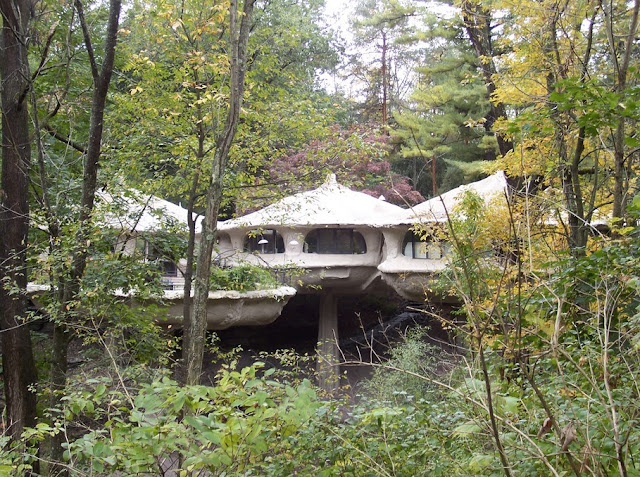
Johnson loved concrete.  His personal home - which is for sale right now  - is classic Johnson (concrete with swooping cedar shingled roof). The Mushroom House in nearby Fairport is another concrete formed building.  Another house backs to the woods off Clover Street and is a smaller and slightly earlier version of his own house. I could not live five minutes in any of these houses. They are cold, off putting spaces with little regard for human participation and family building. Nor do they particularly pay attention to the site in which they occupy. None of the three especially open to what’s outside their cement walls.

 But here’s the thing:  I don’t require an artist to make a masterpiece every time they enter their studio. One masterpiece in a lifetime - one brilliant  painting, song, poem or building - is enough to prove the evolution of humankind and that geniuses still walk among us.  

To have completed two or three? Johnson can rest easy; he got there.   

James Johnson personal residence, Penfield, New York—now for sale (above)

The Mushroom House, originally built for Robert and Marget Antell (below)


Sunday, March 6, 2016

A LITTLE MARCH MADNESS


I just ordered Robin Wall Kimmerer’s newest book “Braiding Sweetgrass.”  She writes about nature, about our relationship to plants and how this symbiosis adds up to the human experience. She writes: “Just as all beings have a duty to me, I have a duty to them. An integral part of a human’s education is to know those duties and how to perform them.”  

This connectedness…I’ve  been reading about it all my adult life. It’s the very core of what I might call my “religion.” 

Kimmerer in another passage writes: “To love a place is not enough. We must find ways to heal it.  Each person - human or no - is bound to every other in a reciprocal relationship.”  

That about covers it.  As a guide to live by and adhere to, can you find better? 
`````````````````````````

Body language: non-verbal communication. Has everybody listened to Amy Cuddy’s TED TALK? PLEASE ….do! The 20 minute talk might change your life ( that does happen you know!).  Practise the Superwoman stance….2 minutes…Our bodies can change our minds. Tiny tweeks can bring about big change.

`````````````````````````

Chip and I went to Memorial Art Gallery to see the current exhibition “50 Years of Ebony Fashion.”  Boy, do I ever have mixed feelings about this! First, I feel manipulated. And if I was a minority woman, I’d be REALLY ticked off! In “Black History Month” no less!

How lazy!  If you ARE going to bring in a traveling show like this one, at least link it to regional history.  For instance, we here in Rochester have a long-standing history in the garment industry. What is that history? Who? How did it grow here? What’s being done to enhance and grow the industry now? Minorities are integrated uniquely in Rochester’s style story.  A Rochester black woman started the first francise hair salon. Where is she in the conversation? In fact, what about black hair styles? 
Here I go again! I come down hard on MAG consistently only because I want it to be better! We have what it takes to achieve greatness. Why do we settle for merely o.k.?
``````````````````````
(P.S. My friend tells me that all my criticism about this traveling show is mis-applied...that the show is strictly pointed to specifics that do not include regional history. I suppose she's right. But museum insiders keep wondering why there is diminished attendance and financial support for local museums and I contend the reason is simple: we want to know how we "fit" into these  discussions. When exhibitions becomes too isoteric, are we only talking to the tiny group of insiders who understand the language?)
`````````````````````````````````

Folk art is often unrefined expression. Does this sign fit that definition? I leave it to you to write the script.


Wednesday, February 24, 2016

A POSITIVE CASE FOR PUBLIC ART

(Thank you, Elizabeth Agte. You went on vacation to Florida and posted on fb photographs that inspire this story.)

The small Gulf Coast town of Dunedin, Florida,  (population 35,300, 2010 census) sits just west of Tampa and is known for its Scottish roots which it celebrates in the annual Scottish Heritage Festival. More recently, it named itself “America’s Most Walkable City” but I don’t know how that was measured and against whom. Some might argue that 35,000 souls do not a city make!

Never mind.

Dunedin has a few other bragging points aside from the mere fact that it’s in the Sun Belt and has water access.  It’s the spring training grounds for the Toronto Blue Jays. It sits alongside the Orange Belt Railway. Built by a Russian immigrant in 1885, it was one of the first small gauge rail lines in the U.S. (a mere 3 feet wide) that ran from Sanford to St. Petersburg, a distance of 152 miles. The train line is no longer active but approx. 35 miles of the old bed now form a hiking/biking trail accessible to Dunedinians and visitors as part of the national “rail to trails” program.

Over the years, the town center miraculously resisted any attempt to “update” its commercial district.  No large commercial signs are allowed nor corporate franchise restaurants nor franchise retail stores. The result is an authentic town (usually labeled “quaint”), not the homogenized versions that plague our country from coast to coast. It also means that local commerce must be creative to keep “in the game.”

In 2009, two local residents - artists Steven Spathelf, age 52, and Marsha Goins, age 46, (Marsha also happened to own the Enchanted Branch, a flower/gift shop) decided that art could 1)distinguish the central commercial district, 2)provide unique promotion opportunity and 3)instill pride of place.   They picked oranges (no pun intended) as the shared symbol of their town, pre-scouted the area for smooth walls, invested $150 in paint and at 5 a.m., April 13, 2009, set about the business of painting foot high oranges on business walls. They planned to finish by 8 a.m., clean up and disappear from the scene without getting caught.

Obviously, that didn’t work. They were spotted by people coming to work. They were hugged, chatted with, laughed with and hugged again. No charges of violation were filled. Building owners that failed to get an orange?  See the sign posted by the Chamber of Commerce .

(Just reported: there are now over 350 "oranges" in Dunedin along with an orange parade.)


(Photographs: Elizabeth Agte and the Tampa News)

Saturday, February 6, 2016

Quilts and Golf

I’m feeling especially sad today.  First, I have a cold and then, it’s February and I live in the north. Even when it’s a record setting mild winter like this year, February is still gray and wan. (Can a month be “wan?”) Around me, issues seem wearying whereas - when I am feeling more optimistic - they are energizing sparks, mind puzzles to solve.

For instance, in the suburban community where I live, an off-shore conglomerate is selling it’s locally owned property. Ordinarily, this could be a boon to local citizens but in this case, the property is two nearly adjoining golf courses comprising a bit over 400 acres.  A giant stone quarry sits in the arm pit of these two parcels. The quarry is still being worked but can play out within a few short years when it will become a 200 acre lake fed via underground springs. 

Citizens - as we’ve long known - may SAY they want change but only for other people, never themselves, and if their house is adjacent to a golf course that’s suddenly up for grabs? Pure panic! Meetings are called, people beat a path to the town hall, and armies are enlisted to print and pass along flyers, post lawn signs.

But golf courses are a dying business.  Growth has been flat for decades; golf courses - both private and public - are in trouble nearly everywhere.  Rounds played nationally are down 10 - 20% since 2009.  The National Golf Foundation reports that the game is down 5 million players in the last 10 years and 20% more players are likely to quit in the next few years.

At the other end, fewer younger players are coming onto greens.  The hot demographic - those players between 29 and 49 years old - have very little time to devote to 18 holes of golf and they generally have no extra money for golf trips where time becomes a non-issue.  The game is “too hard” for younger players to feel they can master - and they have a full menu of other activities anyway - and women remain poor beggers at the gate of most golf clubs.  And as if all this isn’t a stacked anti-golf deck, environmentally, golf courses are not very friendly. They are terrible water guzzlers and all those chemicals that keep the grass green filter directly to the water table. 

The perfect solution for my little suburb? I don’t know but it’s out there and I hope political leaders and citizens have the sense and will to find a compromise that elevates the quality of life for everybody, not just a few who happens to have back yards smooching the 9th green.

`````````````````````````````

Pat Pauly
I love quilts. Here are some of my favorites.  Pat Pauly is well-known for taking the quilt into print making/painting/patching arcs of originality.  But here’s a photograph that she posted on Facebook of a new quilt and it’s actually pieced and patched and top stitched and I like it very much.

Season Evans Community Quilt
Season Evans (don’t you swoon at that name?) is new to me but this Community Quilt is brilliant! Go to her website and look at these jewels. The backs are also pieced and quilted in totally unique patterns (and more traditional) from the front -  both sides are “finished art.”

Washington, D.C. foreclosure quilt

Kathryn Clark remains an artist whose work is cerebral and socially relevant as well as interesting to look at.  As soon as I saw her foreclosure quilts, I knew she had that mysterious combination that comes along rarely and I was delighted that the Smithsonian Museum agreed and purchased one of her pieces this year for the Renwick permanent collection.

Denise Schmidt
Denyse Schmidt has found a route that combines art pieces and commercial venture.  She sells quilt designs  - and the material to reach the end results - and teaches classes and writes books and…you get the idea. Therefore, among purist, she sometimes gets one of “those looks.” But I love her sense of graphic design and minimalism.

So here are my picks. The world of quilt making is vast. Make your own list and MAKE YOUR OWN QUILT! (Before golf season starts…)